Amigos de Bolivia is in its 9th year, which started off with a new member, Greg Purdy, a young political activist in Washington Heights. He likes the energy of Evo Morales, and wants to visit Bolivia soon. At present Greg is working on a weekend in the Dominican Republic, lots of Dominicanos here in the hood want him to see their island paradise, where he could practice his Spanish.
Naturally, a topic of conversation was the new Trump era in the US, and how the new State Department under Rex Tillerson will deal with Bolivia. We look forward to improved relations, and will compose a letter to Mr Tillerson to give him our support.
One thing that Greg wants to see instituted is a selective amnesty, modeled on the amnesty that Ronald Reagan gave to Latin immigrants in the '80s. It worked. Why the Bush 41, Clinton, Bush 43, and Obama did not make an amnesty is beyond words.
Greg is also supporting a Latin candidate for Mayor of New York, Daby Carreras. Earlier this month one of Greg's friends introduced a New York Times reporter to Daby, hopefully the paper will have access to his campaign. One issue with the new regime is that the press is getting shut out at times.
So we hope that our new member will be able to get his amnesty idea put forward and get it to the press so it will have the support it needs, along with positive press for Bolivia.
Showing posts with label New York Times. Show all posts
Showing posts with label New York Times. Show all posts
Monday, January 30, 2017

Wednesday, September 21, 2016
Facts about War on Drugs: Bolivia is winning, Colombia, thanks to the US, is losing
The United States constantly berates Evo Morales and insinuates that
he is dealing drugs. However, the facts speak for themselves, and in the
New York Times, 14 September, 2016, (editorial pages) we can
read about how it is Colombia, where the US agencies are actives
allegedly fighting drugs, that drugs are up 40% - while they are being
eradicated in Bolivia. Obama needs to read the papers! And he might note
the 11 September article in the front page of the NYT titled
"U.S. Extradition Benefits Warlords from Colombia: Held to Account for
Decades of Atrocities - Until the Americans Stepped In", by Deborah
Spring. Below is the 14 September NYT article:
This week, the White House issued its yearly report on the nations on the front lines of the war on drugs. Predictably, it listed Bolivia as one of three countries that “failed demonstrably” to do enough to combat the drug trade. President Evo Morales of Bolivia responded, as he does each year, with defiance.
“The world knows that our counternarcotics model is better without the Americans,” Mr. Morales said during an event on Tuesday, alluding to his expulsion of American drug enforcement agents in 2008.
The
yearly condemnation of Bolivia has been futile. So far, that country’s
experience with its drug strategy is showing more promise than
Washington’s forced-eradication model.
Over
the past decade, the Bolivian government has sought to gradually curb
the cultivation of coca — the plant processed to make cocaine — by
establishing a tightly regulated market for its consumption as a
nonnarcotic stimulant. (Bolivians have been chewing coca leaf and using
it to make tea for generations.) The government eradicates unauthorized
crops after negotiating with, and finding alternatives for, growers.
This
approach, which has been supported and financed by the European Union,
has shown significant results. According to the United Nations Office on
Drugs and Crime, coca leaf cultivation in Bolivia has declined each of the past five years. In its latest report,
U.N.O.D.C. said Bolivia had roughly 20,200 hectares (about 78 square
miles) of coca cultivation, a slight drop compared with the previous
year.
These tactics have been hailed by scholars and some Western officials
because they place a premium on the rights and needs of farmers in poor
areas. Coca growers who have voluntarily registered with the government
are given title for small parcels of land and are authorized to grow a
limited amount. Mr. Morales, a former coca growers union leader, has
played a hands-on role in negotiating the terms of this arrangement with
unions and other local leaders.
This
stands in stark contrast to the strategy the United States has long
financed in the region — a combination of aerial herbicide spraying,
manual eradication and the prosecution of drug kingpins in the United
States. The inadequacy of this approach is most obvious in Colombia,
which has been Washington’s closest ally in Latin America on
counternarcotics.
Last year, coca cultivation in Colombia increased by nearly 40 percent compared with the previous year, according to U.N.O.D.C. The
tough-on-crime approach has often exacerbated violence there. Colombia,
however, did not get the “failed demonstrably” label. It may be time
for Washington to drop that marker altogether and study the merits of
innovative approaches, including Bolivia’s.
Tuesday, March 1, 2016
New York Times on Bolivia; journalism or malicious gossip?
For years we have passed information to the New York Times and other papers. They have ignored it, even when a Bolivian consul offered his house to a NYT journalist and offered to set up an interview with Evo Morales. A press reception in the Bolivian consulate in New York, on 30 June, 2010, was ignored by the NYT, the NY Post and the NY Daily News. A short cab or subway ride away from their offices, or a ten minute walk for any able bodied journalists, was too much to undertake.
Even when Bolivian officials visited this city and spoke at major institutions, such as Colombia University, the journalists here took no note. Morales too spoke, at a convenient midtown location, and they were nowhere to be seen.
Bolivia, twice the size of France, or Texas, with its great diversity ethnically and geographically, has great opportunity for any real journalist. Recently, much of this has been positive, with the great increases in minimum wage, education and living conditions, the creation of more infrastructure and tourism, etc.
But none of this reaches the pages of the New York Times. I seldom get a google alert on my email; but recently it has been a constant stream of alerts about NYT pieces on Bolivia; all hit pieces.
Here is a sampling:
17 Feb (AP) "6 Dead of Asphyxiation in Bolivian Protest"
19 Feb (Editorial Board) "Three Terms is Enough for Morales"
21 Feb (AP) "Ballot Question on Morales Re-election in Trouble"
22 Feb (Nicholas Casey) "Polls Show Bolivian Leader Losing Vote"
25 Feb (Nicholas Casey) "Morales Concedes Defeat"
27 Feb (Nicholas Casey) "Former Lover in Jail"
There is a great irony of all this coming from a town where the former mayor had three terms, and wanted more; Michael Bloomberg. He is a pressman, but there was no such hit campaign against his seeking re-election in the NYT. The public voted for term limits for him and for Morales, as they did with Roosevelt. But somehow the NYT makes this
seem like something terrible is happening in Bolivia, and specifically with Morales' administration, and probes into his personal life, what with claims of a son who passed away but now there is someone claiming the son is alive and a former girlfriend whom he broke up with. No one is sure what is happening, but busybodies are spending their time consumed with it.
I thought such kind of reporting was in the National Enquirer, along with Elvis sightings and UFOs.
Even when Bolivian officials visited this city and spoke at major institutions, such as Colombia University, the journalists here took no note. Morales too spoke, at a convenient midtown location, and they were nowhere to be seen.
Bolivia, twice the size of France, or Texas, with its great diversity ethnically and geographically, has great opportunity for any real journalist. Recently, much of this has been positive, with the great increases in minimum wage, education and living conditions, the creation of more infrastructure and tourism, etc.
But none of this reaches the pages of the New York Times. I seldom get a google alert on my email; but recently it has been a constant stream of alerts about NYT pieces on Bolivia; all hit pieces.
Here is a sampling:
17 Feb (AP) "6 Dead of Asphyxiation in Bolivian Protest"
19 Feb (Editorial Board) "Three Terms is Enough for Morales"
21 Feb (AP) "Ballot Question on Morales Re-election in Trouble"
22 Feb (Nicholas Casey) "Polls Show Bolivian Leader Losing Vote"
25 Feb (Nicholas Casey) "Morales Concedes Defeat"
27 Feb (Nicholas Casey) "Former Lover in Jail"
There is a great irony of all this coming from a town where the former mayor had three terms, and wanted more; Michael Bloomberg. He is a pressman, but there was no such hit campaign against his seeking re-election in the NYT. The public voted for term limits for him and for Morales, as they did with Roosevelt. But somehow the NYT makes this
seem like something terrible is happening in Bolivia, and specifically with Morales' administration, and probes into his personal life, what with claims of a son who passed away but now there is someone claiming the son is alive and a former girlfriend whom he broke up with. No one is sure what is happening, but busybodies are spending their time consumed with it.
I thought such kind of reporting was in the National Enquirer, along with Elvis sightings and UFOs.
Saturday, October 18, 2014
Glenn Greenwald article on Bolivian election

Dean Mouhtaropoulos
One of the most accidentally revealing media accounts highlighting the real meaning of “democracy” in U.S. discourse is a still-remarkable 2002 New York Times Editorial on the U.S.-backed military coup in Venezuela, which temporarily removed that country’s democratically elected (and very popular) president, Hugo Chávez. Rather than describe that coup as what it was by definition - a direct attack on democracy by a foreign power and domestic military which disliked the popularly elected president – the Times, in the most Orwellian fashion imaginable, literally celebrated the coup as a victory for democracy:
More amazingly still, the Times editors told their readers that Chávez’s “removal was a purely Venezuelan affair,” even though it was quickly and predictably revealed that neocon officials in the Bush administration played a central role. Eleven years later, upon Chávez’s death, the Times editors admitted that “the Bush administration badly damaged Washington’s reputation throughout Latin America when it unwisely blessed a failed 2002 military coup attempt against Mr. Chávez” [the paper forgot to mention that it, too, blessed (and misled its readers about) that coup]. The editors then also acknowledged the rather significant facts that Chávez’s “redistributionist policies brought better living conditions to millions of poor Venezuelans” and “there is no denying his popularity among Venezuela’s impoverished majority.”
If you think The New York Times editorial page has learned any lessons from that debacle, you’d be mistaken. Today they published an editorial expressing grave concern about the state of democracy in Latin America generally and Bolivia specifically. The proximate cause of this concern? The overwhelming election victory of Bolivian President Evo Morales (pictured above), who, as The Guardian put it, “is widely popular at home for a pragmatic economic stewardship that spread Bolivia’s natural gas and mineral wealth among the masses.”
The Times editors nonetheless see Morales’ election to a third term not as a vindication of democracy but as a threat to it, linking his election victory to the way in which “the strength of democratic values in the region has been undermined in past years by coups and electoral irregularities.” Even as they admit that “it is easy to see why many Bolivians would want to see Mr. Morales, the country’s first president with indigenous roots, remain at the helm” – because “during his tenure, the economy of the country, one of the least developed in the hemisphere, grew at a healthy rate, the level of inequality shrank and the number of people living in poverty dropped significantly” - they nonetheless chide Bolivia’s neighbors for endorsing his ongoing rule: “it is troubling that the stronger democracies in Latin America seem happy to condone it.”
The Editors depict their concern as grounded in the lengthy tenure of Morales as well as the democratically elected leaders of Ecuador and Venezuela: “perhaps the most disquieting trend is that protégés of Mr. Chávez seem inclined to emulate his reluctance to cede power.” But the real reason the NYT so vehemently dislikes these elected leaders and ironically views them as threats to “democracy” becomes crystal clear toward the end of the editorial (emphasis added):
It is, of course, true that democratically elected leaders are capable of authoritarian measures. It is, for instance, democratically elected U.S. leaders who imprison people without charges for years, build secret domestic spying systems, and even assert the power to assassinate their own citizens without due process. Elections are no guarantee against tyranny. There are legitimate criticisms to be made of each of these leaders with regard to domestic measures and civic freedoms, as there is for virtually every government on the planet.
But the very idea that the U.S. government and its media allies are motivated by those flaws is nothing short of laughable. Many of the U.S. government’s closest allies are the world’s worst regimes, beginning with the uniquely oppressive Saudi kingdom (which just yesterday sentenced a popular Shiite dissident to death) and the brutal military coup regime in Egypt, which, as my colleague Murtaza Hussain reports today, gets more popular in Washington as it becomes even more oppressive. And, of course, the U.S. supports Israel in every way imaginable even as its Secretary of State expressly recognizes the “apartheid” nature of its policy path.
Just as the NYT did with the Venezuelan coup regime of 2002, the U.S. government hails the Egyptian coup regime as saviors of democracy. That’s because “democracy” in U.S. discourse means: “serving U.S. interests” and “obeying U.S. dictates,” regardless how how the leaders gain and maintain power. Conversely, “tyranny” means “opposing the U.S. agenda” and “refusing U.S. commands,” no matter how fair and free the elections are that empower the government. The most tyrannical regimes are celebrated as long as they remain subservient, while the most popular and democratic governments are condemned as despots to the extent that they exercise independence.
To see how true that is, just imagine the orgies of denunciation that would rain down if a U.S. adversary (say, Iran, or Venezuela) rather than a key U.S. ally like Saudi Arabia had just sentenced a popular dissident to death. Instead, the NYT just weeks ago uncritically quotes an Emirates ambassador lauding Saudi Arabia as one of the region’s “moderate” allies because of its service to the U.S. bombing campaign in Syria. Meanwhile, the very popular, democratically elected leader of Bolivia is a grave menace to democratic values – because he’s “dismal for Washington’s influence in the region.”
Photo: Dean Mouhtaropoulos/Getty Images
With yesterday’s resignation of President Hugo Chávez, Venezuelan democracy is no longer threatened by a would-be dictator. Mr. Chávez, a ruinous demagogue, stepped down after the military intervened and handed power to a respected business leader, Pedro Carmona.Thankfully, said the NYT, democracy in Venezuela was no longer in danger . . . because the democratically-elected leader was forcibly removed by the military and replaced by an unelected, pro-U.S. “business leader.” The Champions of Democracy at the NYT then demanded a ruler more to their liking: “Venezuela urgently needs a leader with a strong democratic mandate to clean up the mess, encourage entrepreneurial freedom and slim down and professionalize the bureaucracy.”
More amazingly still, the Times editors told their readers that Chávez’s “removal was a purely Venezuelan affair,” even though it was quickly and predictably revealed that neocon officials in the Bush administration played a central role. Eleven years later, upon Chávez’s death, the Times editors admitted that “the Bush administration badly damaged Washington’s reputation throughout Latin America when it unwisely blessed a failed 2002 military coup attempt against Mr. Chávez” [the paper forgot to mention that it, too, blessed (and misled its readers about) that coup]. The editors then also acknowledged the rather significant facts that Chávez’s “redistributionist policies brought better living conditions to millions of poor Venezuelans” and “there is no denying his popularity among Venezuela’s impoverished majority.”
If you think The New York Times editorial page has learned any lessons from that debacle, you’d be mistaken. Today they published an editorial expressing grave concern about the state of democracy in Latin America generally and Bolivia specifically. The proximate cause of this concern? The overwhelming election victory of Bolivian President Evo Morales (pictured above), who, as The Guardian put it, “is widely popular at home for a pragmatic economic stewardship that spread Bolivia’s natural gas and mineral wealth among the masses.”
The Times editors nonetheless see Morales’ election to a third term not as a vindication of democracy but as a threat to it, linking his election victory to the way in which “the strength of democratic values in the region has been undermined in past years by coups and electoral irregularities.” Even as they admit that “it is easy to see why many Bolivians would want to see Mr. Morales, the country’s first president with indigenous roots, remain at the helm” – because “during his tenure, the economy of the country, one of the least developed in the hemisphere, grew at a healthy rate, the level of inequality shrank and the number of people living in poverty dropped significantly” - they nonetheless chide Bolivia’s neighbors for endorsing his ongoing rule: “it is troubling that the stronger democracies in Latin America seem happy to condone it.”
The Editors depict their concern as grounded in the lengthy tenure of Morales as well as the democratically elected leaders of Ecuador and Venezuela: “perhaps the most disquieting trend is that protégés of Mr. Chávez seem inclined to emulate his reluctance to cede power.” But the real reason the NYT so vehemently dislikes these elected leaders and ironically views them as threats to “democracy” becomes crystal clear toward the end of the editorial (emphasis added):
This regional dynamic has been dismal for Washington’s influence in the region. In Venezuela, Bolivia and Ecuador, the new generation of caudillos [sic] have staked out anti-American policies and limited the scope of engagement on development, military cooperation and drug enforcement efforts. This has damaged the prospects for trade and security cooperation.You can’t get much more blatant than that. The democratically elected leaders of these sovereign countries fail to submit to U.S. dictates, impede American imperialism, and subvert U.S. industry’s neoliberal designs on the region’s resources. Therefore, despite how popular they are with their own citizens and how much they’ve improved the lives of millions of their nations’ long-oppressed and impoverished minorities, they are depicted as grave threats to “democracy.”
It is, of course, true that democratically elected leaders are capable of authoritarian measures. It is, for instance, democratically elected U.S. leaders who imprison people without charges for years, build secret domestic spying systems, and even assert the power to assassinate their own citizens without due process. Elections are no guarantee against tyranny. There are legitimate criticisms to be made of each of these leaders with regard to domestic measures and civic freedoms, as there is for virtually every government on the planet.
But the very idea that the U.S. government and its media allies are motivated by those flaws is nothing short of laughable. Many of the U.S. government’s closest allies are the world’s worst regimes, beginning with the uniquely oppressive Saudi kingdom (which just yesterday sentenced a popular Shiite dissident to death) and the brutal military coup regime in Egypt, which, as my colleague Murtaza Hussain reports today, gets more popular in Washington as it becomes even more oppressive. And, of course, the U.S. supports Israel in every way imaginable even as its Secretary of State expressly recognizes the “apartheid” nature of its policy path.
Just as the NYT did with the Venezuelan coup regime of 2002, the U.S. government hails the Egyptian coup regime as saviors of democracy. That’s because “democracy” in U.S. discourse means: “serving U.S. interests” and “obeying U.S. dictates,” regardless how how the leaders gain and maintain power. Conversely, “tyranny” means “opposing the U.S. agenda” and “refusing U.S. commands,” no matter how fair and free the elections are that empower the government. The most tyrannical regimes are celebrated as long as they remain subservient, while the most popular and democratic governments are condemned as despots to the extent that they exercise independence.
To see how true that is, just imagine the orgies of denunciation that would rain down if a U.S. adversary (say, Iran, or Venezuela) rather than a key U.S. ally like Saudi Arabia had just sentenced a popular dissident to death. Instead, the NYT just weeks ago uncritically quotes an Emirates ambassador lauding Saudi Arabia as one of the region’s “moderate” allies because of its service to the U.S. bombing campaign in Syria. Meanwhile, the very popular, democratically elected leader of Bolivia is a grave menace to democratic values – because he’s “dismal for Washington’s influence in the region.”
Photo: Dean Mouhtaropoulos/Getty Images
Email the author: glenn.greenwald@theintercept.com
Saturday, October 11, 2014
New York Times article by Martin Sivak on the 12 Octobr election
This article appeared in the Opinion pages of the New York Times on 10 October, 2014, two days before the Bolivian national elections. While this site does not agree with all the author's views, his piece is well written and informative and much better than the usual anti-Morales diatribe written in the US press.
_____________________________________________________________________
_____________________________________________________________________
BUENOS AIRES — On Sunday, Bolivians are widely expected to re-elect their president, Evo Morales, for an unprecedented third term. He is still overwhelmingly popular, including among the indigenous people from whom he has sprung. Their conditions of life have improved dramatically since he first took office in 2006, and so has the general economy. But that extraordinary popularity could ultimately prove a weakness for Bolivia, since he has so far shown no inclination to groom a successor and a strong political party to assure that his transformation of Bolivia does not fade when he inevitably leaves office.
For certain, Bolivia has shown the world an assertive, if sometimes startling, national image of late. Thanks to loans from China, the Internet reaches rural schools via a satellite that bears the name of Tupac Katari, the leader of an important indigenous uprising against Spanish colonial rule. Like Mr. Morales, Bolivia’s current foreign minister, David Choquehuanca, belongs to the Aymara, one of the 36 ethnic groups recognized by Bolivia. Following a visit to London, he proposed to change the hands of the clock at the Plurinational Legislative Assembly, the Bolivian equivalent of Congress, so that they move counterclockwise — symbol of Bolivia’s recent spirit of change and independence in the Southern Hemisphere. Another example: the government maintains a vehemently anti-American discourse even as it promises Bolivian students scholarships to study at Harvard and Stanford.
What seems clear is that Bolivia is defying longstanding caricatures of itself as an icon of political instability. Economic stability has followed the political achievement, and opinion polls have given the president a 40 percent advantage over his closest rival. If he wins, it will give him a third term — a possibility based on a constitutional change that he initiated but that his detractors say he is misusing.
Even so, his popularity endures. Under his Movement Toward Socialism, poverty dropped to 45 percent in 2011. In 2005, it had been 64 percent. Mr. Morales is also the first indigenous president of Bolivia, where 48 percent of the population declared themselves indigenous in the last census, and his government has proven itself adept at reconciling ancestral knowledge with economic modernization.
All of this has left Bolivia in the grip of the leftist or populist trend in South American politics that was rising at the turn of the 21st century, even though that trend has slowed in Venezuela, Brazil, Uruguay and Argentina. In the United States, business and foreign policy figures have long portrayed Mr. Morales as an authoritarian strongman who connects emotionally to the masses and was bankrolled by Hugo Chávez, the populist leader and ally of Cuba who governed Venezuela from 1999 until his death last year.
But the notion of a mentor/student relationship underestimates Mr. Morales and overestimates Mr. Chávez. With Mr. Chávez gone, there is little Venezuelan aid to speak of today. But Bolivia is expected to finish the year with the highest growth rate in South America — above 5 percent. During his time in office, per capita income has grown from $1,000 to $2,550 and unemployment levels have remained below double digits. Between 2006 and 2014, $8 billion of oil income was disbursed to social programs for young people, the elderly and young mothers. Mr. Morales’s most emphatic opponents accuse him of being authoritarian, uneducated and intransigent, but don’t challenge his personal integrity.
In Bolivia, presidents govern from the Palacio Quemado (the Burnt Palace), a name earned in 1875 when it was set on fire with torches. It hints at Bolivia’s well-earned identity as a flammable country: of 83 governments, 36 lasted a year or less and 37 were anti-democratic.
If he is re-elected and serves out his term, Mr. Morales will have achieved the longest staying power of any president: 14 years. During his first term, the resource-rich east seemed on the verge of secession, but he managed to dismantle the regional opposition. Since then, domestic political opposition has been erratic. For this election, most of the other contenders are simply framing themselves as better administrators of the existing system.
Nationalizations, most importantly of the hydrocarbon industry, have been the pillars supporting this agenda. Another point in the government’s favor was the country’s new constitution, which improved representation in a country long characterized by crippling social exclusion. Not long ago, in La Paz, I asked a street soup vendor’s 11- year-old son what he wanted to be when he grew up. “President,” he said. “President like Evo.” That the son of a mujer de pollera, an urban indigenous woman, can see himself as president illustrates the seismic change in Bolivia.
Relations with the United States are touchy at best, principally over coca production. President Obama has again declared that Bolivia “failed demonstrably” in its counternarcotics efforts, which meant the United States would continue to withhold aid. But the United Nations Office on Drugs and Crime has praised the Bolivian government’s efforts to tackle coca production, so the American move may only have isolated the United States in the region. The plant’s leaves, chewed for extra energy at Andean altitudes, are deep in Bolivian tradition, and Mr. Morales himself once led the coca growers union. So framing relations within the context of the fight against drugs is a perspective that has severe limitations in Bolivia.
If Mr. Morales wins the election, he must now look forward, and use his third term to create the necessary conditions for a plausible successor. That the political process is so strongly identified with him has only contributed to the lack of potential successors. No important leaders have emerged; President Morales’s ruling party has not grown stronger; and up to now, he has not considered stepping down. On the contrary, he has increasingly concentrated his power and made decisions on his own.
The problem of this strong personal identification with the presidency will only grow more acute if his legislators press to modify the constitution in order to guarantee Mr. Morales’s unlimited re-election (all he needs is two-thirds of the vote on Sunday). Any eternalization will ultimately be a blow to the economic boom and the social progress achieved. The new Bolivia should not allow a president’s cold to escalate into a raging disease.
Martín Sivak, an Argentine journalist, is the author of “Evo Morales: The Extraordinary Rise of the First Indigenous President of Bolivia.” This essay was translated by Kristina Cordero from the Spanish.
Monday, September 29, 2014
Bolivian public transport: cable cars offer unique city views
Here is an article published in the New York Times, by Alissa Walker on 19 August, 2014.
Watch How Bolivia Built The World's Longest Urban Cable Car System
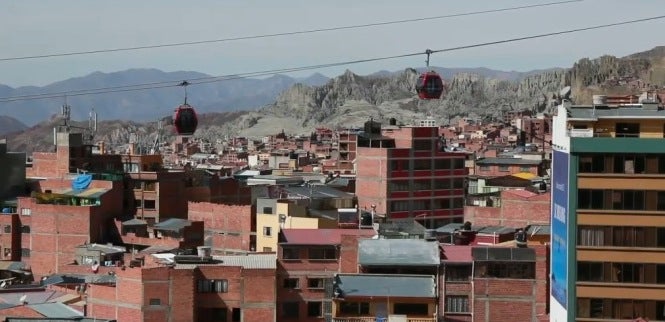 In most parts of the world, cable cars are relegated to ski areas or amusement parks. But in South America, cities use the gondolas to navigate undulating terrain as public transportation. Later htis year, two more lines will open in Bolivia’s La Paz-El Alto network, making it the longest urban cable car system in the world.
This new “subway in the sky” (which looks pretty much like a bunch of ski lifts) is able to lift residents up and over the urban gridlock, allowing them to move between the two city centres faster and more efficiently. As part of a story this weekend, the New York Times made a beautiful video celebrating this rather elegant transit system, which residents call the “red line.”
The potential for this new method of transportation to transform cities like La Paz is huge, where the city is built on veritable alpine cliffs 3600m above sea level. Cable cars provide a light touch on city infrastructure, and can connect steep neighbourhoods where trains are too impractical or expensive. It’s also cleaner and safer than the other alternative — the addition of more crowded minibuses, which will only lead to more streets choked with traffic and pollution.
But the biggest takeaway for riders is that they now feel their city is moving forward, and modernising in a way that will help it keep pace in the global economy (it’s no coincidence these new lines are being finished in time for an election year). Besides their new perspective-changing commute, the cable cars have given the city a signature method of transportation — which brings residents a sense of pride
Watch How Bolivia Built The World's Longest Urban Cable Car System
This new “subway in the sky” (which looks pretty much like a bunch of ski lifts) is able to lift residents up and over the urban gridlock, allowing them to move between the two city centres faster and more efficiently. As part of a story this weekend, the New York Times made a beautiful video celebrating this rather elegant transit system, which residents call the “red line.”
The potential for this new method of transportation to transform cities like La Paz is huge, where the city is built on veritable alpine cliffs 3600m above sea level. Cable cars provide a light touch on city infrastructure, and can connect steep neighbourhoods where trains are too impractical or expensive. It’s also cleaner and safer than the other alternative — the addition of more crowded minibuses, which will only lead to more streets choked with traffic and pollution.
But the biggest takeaway for riders is that they now feel their city is moving forward, and modernising in a way that will help it keep pace in the global economy (it’s no coincidence these new lines are being finished in time for an election year). Besides their new perspective-changing commute, the cable cars have given the city a signature method of transportation — which brings residents a sense of pride
Thursday, May 1, 2014
anti-Soviet ops heating up for the cold war
Things are heating up in the Crimea - now that it is part of Russia, the New York Times is writing about how bad it is since a Ukranian was not able to get good service at the consulate. As if after the US 'annexing' Iraq and Afghanistan the natives were able to get any service at all anywhere...
So Professor Cohen at NYU is now telling us we are in the middle of a cold war.
Cold wars seem to go all over the globe...they include media wars and trade wars, with a umber of Soviets now blacklisted from the US and US citizens barred from doing business with them.
And in all Soviet friendly countries, there are agents making 'cold war'...it is as cold-blooded as any warm war, or hot war. Not cool!
In Bolivia there are already agents working to destabilize Morales and make sure he does not get into office a third time. In other Soviet friendly countries expect much the same - pay good attention for instance to Cabinda, the mineral rich province of Angola.
One agent to look out for is John Holbert, traveling on a Surinam passport, really a DIA agent -
his real name we will leak later, so stay tuned.
At 666 Fifth Avenue - note the address, the good folks at Carlyle had a meeting about Russia and Bolivia etc., supposed to be secret but I guess Carlos got a hold of some of the info...
And Carlos likes to leak things so, like I said, stay tuned.
CR
So Professor Cohen at NYU is now telling us we are in the middle of a cold war.
Cold wars seem to go all over the globe...they include media wars and trade wars, with a umber of Soviets now blacklisted from the US and US citizens barred from doing business with them.
And in all Soviet friendly countries, there are agents making 'cold war'...it is as cold-blooded as any warm war, or hot war. Not cool!
In Bolivia there are already agents working to destabilize Morales and make sure he does not get into office a third time. In other Soviet friendly countries expect much the same - pay good attention for instance to Cabinda, the mineral rich province of Angola.
One agent to look out for is John Holbert, traveling on a Surinam passport, really a DIA agent -
his real name we will leak later, so stay tuned.
At 666 Fifth Avenue - note the address, the good folks at Carlyle had a meeting about Russia and Bolivia etc., supposed to be secret but I guess Carlos got a hold of some of the info...
And Carlos likes to leak things so, like I said, stay tuned.
CR
Friday, February 21, 2014
New York Times reporting on Bolivia's vibrant economy
This is a very positive article in the New York Times, which is usually negative to neutral on Bolivia; it reinforces what was being said on this blog for years about the Bolivian economy, especially after meeting Luis Alberto Arce Catacora, Minister of Economics and Public Finance when he came to talk at Columbia University in April, 2010 [see post for 24 April, 2010 on this blog].
We welcome this are this kind of accurate reporting from the NYT. William Neuman wrote this article, with assistance from Monica Machicao; Neuman, along with Simon Romero, are the two most senior NYT reporters to cover Latin America and I have always liked Neuman's tone and style. His piece appeared on the internet on 16 February, and in print on pp. A4/A8 the next day:
A large market in El Alto, a working-class city in Bolivia. From colorful mansions to a proliferation of bakeries, there are signs that many have extra cash to spend. Meridith Kohut for The New York Times


We welcome this are this kind of accurate reporting from the NYT. William Neuman wrote this article, with assistance from Monica Machicao; Neuman, along with Simon Romero, are the two most senior NYT reporters to cover Latin America and I have always liked Neuman's tone and style. His piece appeared on the internet on 16 February, and in print on pp. A4/A8 the next day:
LA PAZ, Bolivia — Argentina’s currency has plunged, setting off global worries about developing economies. Brazil is struggling to shake concerns over years of sluggish growth. Venezuela, which sits atop the world’s largest oil reserves, has one of the world’s highest inflation rates. Farther afield, countries like Turkey and South Africa have watched their currencies suffer as investors search for safer returns elsewhere.
And then there is Bolivia.
Tucked away in the shadow of its more populous and more prosperous neighbors, tiny, impoverished Bolivia, once a perennial economic basket case, has suddenly become a different kind of exception — this time in a good way.
Its economy grew an estimated 6.5 percent last year, among the strongest rates in the region. Inflation has been kept in check. The budget is balanced, and once-crippling government debt has been slashed. And the country has a rainy-day fund of foreign reserves so large — for the size of its economy — that it could be the envy of nearly every other country in the world.
“Bolivia has been in a way an outlier,” said Ana Corbacho, the International Monetary Fund’s chief of mission here, adding that falling commodity prices and other factors have downgraded economic expectations throughout the region. “The general trend is we have been revising down our growth forecast, except for Bolivia we have been revising upward.”
Bolivia has taken an unlikely path to becoming the darling of international financial institutions like the monetary fund, not least because the high praise today is coming from some of the same institutions that the country’s socialist president, Evo Morales, loves to berate.
Mr. Morales often speaks harshly of capitalism and some of its most ardent defenders, like big corporations, the United States, the monetary fund and the World Bank. He nationalized the oil and gas sector after taking office in 2006, and he has expropriated more than 20 private companies in a variety of industries.

Yet while Mr. Morales calls himself a revolutionary, others have begun using a very different word to describe him: “prudent.”
Both the monetary fund and the World Bank, in recent reports, praised what they called Mr. Morales’s “prudent” macroeconomic policies. Fitch Ratings, a major credit rating agency, cited his “prudent fiscal management.”
While Mr. Morales remains firmly in Latin America’s leftist camp, on many economic matters he fits within a broader trend away from ideological rigidity in the region.
In Peru, President Ollanta Humala went from ardent leftist to centrist. In Colombia, President Juan Manuel Santos, a former defense minister, now plays the role of peacemaker, negotiating with the country’s largest guerrilla group. In El Salvador, presidential candidates from left and right moved toward the center to woo voters. In Uruguay, President José Mujica, a leftist and a former Marxist guerrilla, has carried out business-friendly economic policies.
“There’s definitely an underappreciated element of pragmatism” in the region, said Maxwell A. Cameron, a professor of political science at the University of British Columbia.
Not long ago, Bolivia was a focal point of political and economic instability, and while it remains South America’s poorest country, much has changed.
Economic growth last year was the strongest in at least three decades, according to the monetary fund, and it continued a string of several years of healthy growth. The portion of the population living in extreme poverty fell to 24 percent in 2011, down from 38 percent in 2005, the year before Mr. Morales took office.
Though there is still much misery, the economic transformation is widely visible, in thriving urban markets or in the new tractors tilling land where farm animals pulled plows not long ago. In El Alto, a working-class city perched above the capital, the newly wealthy flaunt their success in the form of brightly colored mansions. Another recent addition: the proliferation of bakeries selling elaborate cakes, a sign that even those of more modest means have extra cash to spend.
Though there is still much misery, the economic transformation is widely visible, in thriving urban markets or in the new tractors tilling land where farm animals pulled plows not long ago. In El Alto, a working-class city perched above the capital, the newly wealthy flaunt their success in the form of brightly colored mansions. Another recent addition: the proliferation of bakeries selling elaborate cakes, a sign that even those of more modest means have extra cash to spend.
One of the most surprising developments is the way that Bolivia has amassed foreign currency, salting away a rainy-day fund of about $14 billion, equal to more than half of its gross domestic product, or 17 months of imports, that can help it get through economic hard times.
According to the monetary fund, Bolivia has the highest ratio in the world of international reserves to the size of its economy, having recently surpassed China in that regard.
“We are showing the entire world that you can have socialist policies with macroeconomic equilibrium,” said Economy and Finance Minister Luis Arce. “Everything we are going to do is directed at benefiting the poor. But you have to do it applying economic science.”
The country is doing well thanks to relatively high prices for natural gas — its most important export — during Mr. Morales’s presidency. That enabled Mr. Morales to order in November that all government and many private sector workers get double the customary year-end bonus of a full month’s salary.
It was a populist move that critics linked to the coming election season — Mr. Morales will run for a new term in October. But it is consistent with a broader effort to redistribute wealth and direct some of the country’s natural gas income directly into people’s pockets.
“I wouldn’t necessarily say these are mainstream economic policies,” Ms. Corbacho said. “What we have assessed as very positive are the outcomes they have achieved when it comes to growth, social indicators” and other criteria.
Bolivia’s turnaround is noteworthy because for many years the country was a proving ground for the kind of orthodox, free market policies long promoted by the monetary fund and other international institutions. Grappling with a host of economic problems, including hyperinflation that reached 24,000 percent in 1985, the government cut spending, eliminated fuel subsidies, partially privatized government-owned companies and fired many workers.
Critics say that while those policies tamed inflation, they also did long-term damage, exacerbating the unequal distribution of wealth, pushing newly out-of-work miners and farmers into coca farming that increased cocaine production, and ultimately contributing to the social unrest that helped usher in Mr. Morales as president.
“The Morales administration has basically cast off the recommendations of the I.M.F. and other huge international lending organizations, and for the first time, during his tenure, you see those macroeconomic indicators improve significantly, which finally gains the approval of organizations like the I.M.F.,” said Kathryn Ledebur, director of the Andean Information Network, a research group based in Bolivia.
Mr. Morales has benefited by being president during a time of high commodity prices, which have driven economic growth here and in many countries throughout the region. In a highly contentious move, he nationalized the energy sector by taking a greater stake in the companies that extract the nation’s gas and demanding a bigger share of the revenues. That has greatly increased government income, giving him the money to pay for social programs like cash payments to young mothers, improved pensions and infrastructure projects.
But while the nationalization rattled foreign investors, Mr. Morales now gets generally good marks for the way he has handled the windfall.
“You could mismanage this opportunity, and the reality is they have not,” said Faris Hadad-Zervos, the resident representative of the World Bank in La Paz, who cited the large foreign reserves stock and substantial increases in government spending on infrastructure.
Not that there are no areas of concern. Both the monetary fund and the World Bank say much more should be done to encourage private investment. Bolivia has less than half the rate of private investment of most other countries in South America.
There are also worries about what will happen if natural gas prices fall significantly, and whether Bolivia is simply in the midst of the typical boom-and-bust cycle that often bedevils poor countries.
There are also worries about what will happen if natural gas prices fall significantly, and whether Bolivia is simply in the midst of the typical boom-and-bust cycle that often bedevils poor countries.
Bolivia’s gas exports go entirely to Brazil and Argentina on long-term contracts, meaning that sustained economic problems in those countries could eventually spell problems for Bolivia. But a greater concern is over a low level of investment in gas exploration, which could endanger Bolivia’s ability to maintain production levels in the future.
“This is not sustainable in the long term,” said Jose L. Valera, a lawyer based in Houston who has represented energy companies doing business in Bolivia. “The model is not designed to generate substantial profits for an oil industry that is going to then be incentivized to reinvest in Bolivia.”
Bolivia’s relations with the monetary fund and the World Bank, both based in Washington, are a sharp contrast to those of some of its leftist allies. Venezuela, Ecuador and Argentina refuse to take part in annual economic reviews by the monetary fund.
Mr. Morales’s public statements have also often been highly critical. He once said the World Bank tried to blackmail him into changing his economic policies. And in a speech in December 2012, he called for the dismantling of “the international financial system and its satellites, the I.M.F. and the World Bank.”
But his attitude toward the bank seemed to have changed in July at an event to announce a World Bank project to support quinoa farmers.
“The World Bank does not blackmail, or impose conditions, not anymore,” Mr. Morales said, according to a publication on the bank’s website. To celebrate, he played a friendly soccer game with the bank’s president, Jim Yong Kim.
.
Tuesday, April 19, 2011
Bolivian Manna
Yesterday's New York Times had an article on the front page about quinoa, and how it is being used for Passover; with a few questions, of course, about how kosher it is, which I guess will be determined by seeing if it chews it cud or has a cloven hoof.
Luis Alberto Arce Catacora, Minister of Economics and Public Finance, when he spoke at Columbia University last year, mentioned this crop as one of the resources of Bolivia. It has indeed been a boom, so much so that the Western demand has driven the price of it up in Bolivia for the locals. Which was also a feature of a recent NYT article by Simon Romero.
Luis Alberto Arce Catacora, Minister of Economics and Public Finance, when he spoke at Columbia University last year, mentioned this crop as one of the resources of Bolivia. It has indeed been a boom, so much so that the Western demand has driven the price of it up in Bolivia for the locals. Which was also a feature of a recent NYT article by Simon Romero.
Saturday, April 24, 2010
Earth Day in Bolivia
This is a nice piece I pinched from http://www.itsgettinghotinhere.org/
It was funny that none of the major papers in New York ran anything on this...
So here is a really great article by Joshua Kahn Russell, posted to their site on 22 April.
This morning my email inbox was full of advocacy groups commemorating the 40th anniversary of Earth Day. As the ecological systems that support life are reaching their brink, there is certainly a good reason to use this opportunity to shine a spotlight on a range of issues and challenges. But activist organizations aren’t alone in commemorating today.
Today I was struck even more by corporations trying to capitalize on Earth Day to green their images. As Becky Tarbotton observed in the Huffington Post, the New York Times summarized the situation well: “So strong was the antibusiness sentiment for the first Earth Day in 1970 that organizers took no money from corporations and held teach-ins ‘to challenge corporate and government leaders’… Forty years later, the day has turned into a premier marketing platform for selling a variety of goods and services, like office products, Greek yogurt and eco-dentistry.”
Against this backdrop, World People’s Conference on Climate Change and the Rights of Mother Earth in Cochabamba today is a breath of fresh air.
The Indigenous Environmental Network celebrated today by explaining that “this morning Bolivian President Evo Morales was joined by representatives of 90 governments and several Heads of State to receive the findings of the conference on topics such as a Climate Tribunal, Climate Debt, just finance for mitigation and adaptation, agriculture, and forests. The working group on forests held one of the more hotly contested negotiations of the summit, but with the leadership of Indigenous Peoples, a consensus was reached to reject REDD and call for wide-scale grassroots reforestation programs.”
Jason Negrón-Gonzales of Movement Generation elaborated on how they do Earth Day in Cochabamba: “…from now I’ll be talking to my children and 2010 will be remembered as the year that Earth Day took on new meaning. It will be the year that humanity turned a corner in our relationship to Mother Earth and began struggling along a new course…more than politics, the conference in Cochabamba brought to the table humanity’s relationship with Pachamama. This question, raised most pointedly by the Indigenous communities present, was reflected in the project of creating a declaration of Mother Earth Rights, but also went way beyond it. Can we really reach a sustainable relationship with the Earth unless we stop looking at it as something to be conquered or fixed that is outside of us? How would it change our lives and our struggles if we thought, as Leonardo Boff of Brazil said, ‘Todo lo que existe merece existir, y todo lo que vive merece vivir (Everything that exists deserves to exist, and everything that lives deserves to live)’? Or if we understood the Earth as a living thing that we are a part of and that, ‘La vida es un momento de la tierra, y la vida humana un momento de la vida (Life is a moment of the earth, and the human life is a moment of life)’?”
And the politics do matter. The cross-pollination of grassroots social movements in Bolivia are charting a course and global program that articulates both an analysis of the state of play of the United Nations negotiations as well as a set of solutions moving forward. Jason helped outline the core points of the ABC’s of the Climate Negotiations distilled from analysis coming out of the Cochabamba conference:
1. The key question (aside from decreasing emissions) in negotiations is how to divide up the atmospheric space left for emissions given that the US and other developed countries already used up most of the space that there was for greenhouse gas emissions. This then leads to the obvious follow-up question of whether or not the same countries that overused already should get the overwhelming share of what’s left. The obvious answer that most children would tell you is that no – that isn’t fair, or for that matter, just or equitable. Yet when a country like the US says it can’t or won’t cut emissions to the level it demands of others, that’s what happens.
2. Many countries in the Global South, and certainly the Bolivian government, believe that when developed countries like the US need to decrease their emissions that we should do it domestically, in US industries and the US economy, instead of creating carbon markets that let the US pollute away while paying someone else to decrease for them. This makes sense because history has shown that the projects that are supposed to “offset” emissions in the US or EU are often dubious, or might have happened anyway, or cause other problems for the people who live where they are happening (like with dams).
3. Regardless of the above points, the rich nations pushing the current arena of international negotiations are not seeking to get industrialized countries to decrease their own emissions by their fare share. Right now there are two competing options for a global framework to address climate change– a backroom deal the US is trying to move called the Copenhagen Accord, and the continuation of the international negotiations that have been happening according to the UN Framework Convention on Climate Change (UNFCCC) process since the Kyoto Protocol was signed in 1997. You read that right. The US-backed “Copenhagen Accord” has no relationship to the ongoing global negotiations process. As Angelica Navarro, one of the UN climate negotiators from Bolivia told the story, “It (the Copenhagen Accord) was given to us and we were told we had an hour to decide if we would support it enough. How are we supposed to make a decision about the future of the earth in an hour?”
4. The Kyoto Protocol, adopted through the UNFCCC as the global plan to set targets and mechanisms for reducing greenhouse gas emissions in 1997 has lots of well documented problems: a carbon market has allowed developed countries to avoid making real reductions to their emissions, a “clean development mechanism” which has spurred all kinds of destructive projects in the Global South, and the use of offsets which lead to continued pollution in communities of color in industrialized countries while paying projects elsewhere to cut their real or planned emissions. However, on the positive side Kyoto has: shared legal limits on emissions that are (at least prospectively) based on science; the concept of “common but differentiated responsibilities” meaning that those who have polluted the most should have a different burden than those who haven’t; exceptions for Global South countries with the intent of not restricting their development; and an enforcement mechanism if targets aren’t met.
5. The Copenhagen Accord, on the other hand, has: voluntary limits set by each country, no process to reconcile or pressure countries that offer less regardless of responsibility, no enforcement, continued carbon markets with offsets, etc., and an overall target set not by what science says in necessary, but only representing the total of what all the countries offer up. A study done by the EU estimated that if the Copenhagen Accord was approved with the existing commitments by countries it would optimistically only decrease emissions by 2%, probably locking us into a 3.9 degree Celsius temperature increase globally (this comes from a recent MIT study) – which would be a serious disaster.
Just as companies are using Earth Day to green their images, the Copenhagen Accord was an attempt to pretend a lot more is being done than it really is. It gets worse. This Earth Day comes on the heels of the leaked U.S. Government document trying to “Reinforce the perception that the US is constructively engaged in UN negotiations in an effort to produce a global regime to combat climate change,” “managing expectations” of the UN Climate talks in order to undercut critics. Though the story has predictably gotten little attention in the U.S., the 40th anniversary of Earth Day is framed by extremes filling my email inbox: the predatory opportunism of corporations and some governments on one side, and real solutions proposed by Indigenous groups and other front-line communities on the other. Today, I’m grateful for the 15,000 people making history down south.
It was funny that none of the major papers in New York ran anything on this...
So here is a really great article by Joshua Kahn Russell, posted to their site on 22 April.
This morning my email inbox was full of advocacy groups commemorating the 40th anniversary of Earth Day. As the ecological systems that support life are reaching their brink, there is certainly a good reason to use this opportunity to shine a spotlight on a range of issues and challenges. But activist organizations aren’t alone in commemorating today.
Today I was struck even more by corporations trying to capitalize on Earth Day to green their images. As Becky Tarbotton observed in the Huffington Post, the New York Times summarized the situation well: “So strong was the antibusiness sentiment for the first Earth Day in 1970 that organizers took no money from corporations and held teach-ins ‘to challenge corporate and government leaders’… Forty years later, the day has turned into a premier marketing platform for selling a variety of goods and services, like office products, Greek yogurt and eco-dentistry.”
Against this backdrop, World People’s Conference on Climate Change and the Rights of Mother Earth in Cochabamba today is a breath of fresh air.
The Indigenous Environmental Network celebrated today by explaining that “this morning Bolivian President Evo Morales was joined by representatives of 90 governments and several Heads of State to receive the findings of the conference on topics such as a Climate Tribunal, Climate Debt, just finance for mitigation and adaptation, agriculture, and forests. The working group on forests held one of the more hotly contested negotiations of the summit, but with the leadership of Indigenous Peoples, a consensus was reached to reject REDD and call for wide-scale grassroots reforestation programs.”
Jason Negrón-Gonzales of Movement Generation elaborated on how they do Earth Day in Cochabamba: “…from now I’ll be talking to my children and 2010 will be remembered as the year that Earth Day took on new meaning. It will be the year that humanity turned a corner in our relationship to Mother Earth and began struggling along a new course…more than politics, the conference in Cochabamba brought to the table humanity’s relationship with Pachamama. This question, raised most pointedly by the Indigenous communities present, was reflected in the project of creating a declaration of Mother Earth Rights, but also went way beyond it. Can we really reach a sustainable relationship with the Earth unless we stop looking at it as something to be conquered or fixed that is outside of us? How would it change our lives and our struggles if we thought, as Leonardo Boff of Brazil said, ‘Todo lo que existe merece existir, y todo lo que vive merece vivir (Everything that exists deserves to exist, and everything that lives deserves to live)’? Or if we understood the Earth as a living thing that we are a part of and that, ‘La vida es un momento de la tierra, y la vida humana un momento de la vida (Life is a moment of the earth, and the human life is a moment of life)’?”
And the politics do matter. The cross-pollination of grassroots social movements in Bolivia are charting a course and global program that articulates both an analysis of the state of play of the United Nations negotiations as well as a set of solutions moving forward. Jason helped outline the core points of the ABC’s of the Climate Negotiations distilled from analysis coming out of the Cochabamba conference:
1. The key question (aside from decreasing emissions) in negotiations is how to divide up the atmospheric space left for emissions given that the US and other developed countries already used up most of the space that there was for greenhouse gas emissions. This then leads to the obvious follow-up question of whether or not the same countries that overused already should get the overwhelming share of what’s left. The obvious answer that most children would tell you is that no – that isn’t fair, or for that matter, just or equitable. Yet when a country like the US says it can’t or won’t cut emissions to the level it demands of others, that’s what happens.
2. Many countries in the Global South, and certainly the Bolivian government, believe that when developed countries like the US need to decrease their emissions that we should do it domestically, in US industries and the US economy, instead of creating carbon markets that let the US pollute away while paying someone else to decrease for them. This makes sense because history has shown that the projects that are supposed to “offset” emissions in the US or EU are often dubious, or might have happened anyway, or cause other problems for the people who live where they are happening (like with dams).
3. Regardless of the above points, the rich nations pushing the current arena of international negotiations are not seeking to get industrialized countries to decrease their own emissions by their fare share. Right now there are two competing options for a global framework to address climate change– a backroom deal the US is trying to move called the Copenhagen Accord, and the continuation of the international negotiations that have been happening according to the UN Framework Convention on Climate Change (UNFCCC) process since the Kyoto Protocol was signed in 1997. You read that right. The US-backed “Copenhagen Accord” has no relationship to the ongoing global negotiations process. As Angelica Navarro, one of the UN climate negotiators from Bolivia told the story, “It (the Copenhagen Accord) was given to us and we were told we had an hour to decide if we would support it enough. How are we supposed to make a decision about the future of the earth in an hour?”
4. The Kyoto Protocol, adopted through the UNFCCC as the global plan to set targets and mechanisms for reducing greenhouse gas emissions in 1997 has lots of well documented problems: a carbon market has allowed developed countries to avoid making real reductions to their emissions, a “clean development mechanism” which has spurred all kinds of destructive projects in the Global South, and the use of offsets which lead to continued pollution in communities of color in industrialized countries while paying projects elsewhere to cut their real or planned emissions. However, on the positive side Kyoto has: shared legal limits on emissions that are (at least prospectively) based on science; the concept of “common but differentiated responsibilities” meaning that those who have polluted the most should have a different burden than those who haven’t; exceptions for Global South countries with the intent of not restricting their development; and an enforcement mechanism if targets aren’t met.
5. The Copenhagen Accord, on the other hand, has: voluntary limits set by each country, no process to reconcile or pressure countries that offer less regardless of responsibility, no enforcement, continued carbon markets with offsets, etc., and an overall target set not by what science says in necessary, but only representing the total of what all the countries offer up. A study done by the EU estimated that if the Copenhagen Accord was approved with the existing commitments by countries it would optimistically only decrease emissions by 2%, probably locking us into a 3.9 degree Celsius temperature increase globally (this comes from a recent MIT study) – which would be a serious disaster.
Just as companies are using Earth Day to green their images, the Copenhagen Accord was an attempt to pretend a lot more is being done than it really is. It gets worse. This Earth Day comes on the heels of the leaked U.S. Government document trying to “Reinforce the perception that the US is constructively engaged in UN negotiations in an effort to produce a global regime to combat climate change,” “managing expectations” of the UN Climate talks in order to undercut critics. Though the story has predictably gotten little attention in the U.S., the 40th anniversary of Earth Day is framed by extremes filling my email inbox: the predatory opportunism of corporations and some governments on one side, and real solutions proposed by Indigenous groups and other front-line communities on the other. Today, I’m grateful for the 15,000 people making history down south.
Subscribe to:
Comments (Atom)