statcounter

Showing posts with label MAS. Show all posts

Monday, December 29, 2014

Mile high transit over Bolivia

Bolivia Revolutionizes Urban Mass Transit: From the Streets to the Sky

How a spectacular urban cable car system and a new municipal bus program are revolutionizing mass transit in La Paz and El Alto, with the help of some political competition.

Emily Achtenberg 12/26/2014
(Emily Achtenberg)(Emily Achtenberg)

Those searching for revolution in Bolivia may find it in unexpected places. On the streets and in the sky above La Paz, the nation’s capital, and the neighboring indigenous city of El Alto, a genuine transformation of the urban public transportation system is taking shape, against the backdrop of a political competition that is working to the benefit of local residents.
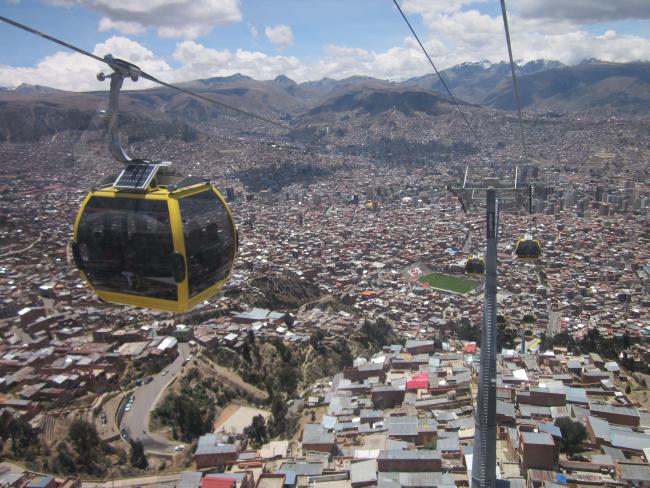
On December 4, President Evo Morales inaugurated the third line of Mi Teleférico (My Cable Car), the spectacular new cable car system launched last May between La Paz and El Alto. With its Red, Yellow, and Green Lines (the colors of the Bolivian flag), 11 stations, and 427 gondola cabins spanning more than 6 miles at 13,500 feet, it is the longest and highest urban cable car system in the world.
Around 100,000 passengers each day—more than 1 out of every 5 commuters between the two cities—are now riding the teleférico to work or school, to buy or sell goods in the local market, or to enjoy family leisure or tourist activities in one location or the other. Compared to the grueling, unpredictable journey in a packed taxi, minivan, or microbus that is the customary mode of local transit, the popular teleférico offers a quick hop in the sky between sleek, modern terminals, with spectacular vistas along the way and free internet at the stations. While the fare of 3 bolivianos (43c) costs more than a minivan ride, passengers who are elderly, disabled, or students pay only half, and the commute takes less than 20 minutes instead of the usual hour.
Morales points to the teleférico as a showpiece of Bolivia’s modernization, made possible by the past nine years of economic prosperity and political stability under his MAS (Movement Towards Socialism) government. It is also being touted as a symbol of integration, breaking down social, economic, and geographic barriers by connecting distant neighborhoods of indigenous migrants to the city’s commercial center, while opening up opportunities for tourism and investment flows to El Alto. As a political project, the teleférico epitomizes the campaign themes of progress, development, technological advancement, and national unity that propelled Morales and the MAS to an overwhelming victory last October.
While the cable system was constructed by the Austrian firm Doppelmayr—one of a handful of companies in the world with the necessary technical expertise—it is also very much a domestic initiative. The $235 million project cost has been financed entirely by Bolivia, with funds amassed largely from hydrocarbons revenues (taxes and royalties) accruing to the government. The construction workforce is largely Bolivian, and Bolivian engineers and technicians are being trained to operate the system.
The teleférico’s capital cost is expected to be amortized in 25 years—earlier than originally anticipated—through a combination of passenger revenues (75%) and commercial income (25%) generated from retail space and billboard rentals at the stations. (Fortunately, no commercial advertising is permitted on the cable cars, which are decorated instead with messages about important Bolivian laws, and, occasionally, with civic symbols such as soccer balls.) While experts remain skeptical, since virtually no public transit system in the world operates in the black, Morales has predicted that profits from the teleférico will soon be used to subsidize the government’s cash transfer programs.
Morales has pledged another $450 million to construct 5 more teleférico lines starting next year, more than doubling the range of the system. Unlike cable cars built in cities like Caracas and Medellin, which reach only a few isolated hilltop neighborhoods, the La Paz/ El Alto teleférico is uniquely envisaged as the core of an urban mass transit system—a “subway in the sky,” as The New York Times has dubbed it. Austrian president Heinz Fisher will travel to Bolivia to sign the new contract on January 22, the day Morales is sworn in for his third presidential term.
Equally popular in La Paz is the new municipal bus system, PumaKatari, (named for the cougar and serpent that symbolize strength and cleverness in Andean culture). Designed to serve the city’s remote and neglected hillside neighborhoods, the system is especially welcomed by poorer residents who live farthest from the center, and are often denied service or charged extra by taxi and minivan drivers. In some cases, angry residents have mobilized to demand the expulsion of minivan lines that provide poor service to their neighborhoods. The municipal buses, with fares of 28c during the day and 43c at night, may cost a little more than prevailing modes of transportation, but offer the same half-price discounts as the teleférico and the convenience and reliability of fixed stops, schedules, and routes.
PumaKatari is the brainchild of Luis Revilla, the popular La Paz mayor elected in 2010 on the left-center MSM (Movement Without Fear) ticket. Revilla supports the teleférico, but insists that it must be part of, and coordinated with, an integrated mass transit system for the La Paz metropolitan region that is efficient, safe, convenient, and meets residents’ needs.
The first phase of PumaKatari was launched in February 2014—just before the teleférico—with 3 routes and 61 buses manufactured by King Long Motors of China. Four new routes and 73 buses have been commissioned for early 2015, with another 4 routes and 60 buses to follow later in the year. The total $30 million capital cost, along with an initial $4 million operating subsidy, is being financed by the municipality, which in turn receives most of its funds from national sources (principally hydrocarbons revenues).
With Bolivia’s departmental and municipal elections scheduled for next March, transportation politics have become a major battleground in the hotly-contested La Paz mayoralty race. Revilla, forced to form a new party when the MSM was decertified after its poor showing in the national elections, collected more than 50,000 signatures in a week to secure standing for the new Sol.bo (Sovereignty and Liberty) ticket.
Sol.bo has since acquired many adherents, especially among MAS dissidents such as former defense minister Cecilia Chacón and TIPNIS leader (and ex-presidential candidate) Fernando Vargas. The party is now organizing a slate of candidates to run for positions throughout the La Paz department, including ex-MAS education minister Félix Patzi for governor.
With Revilla now being mentioned as a potential future rival to Morales, the mayoral campaign and its related transportation issues have become even more competitive and contentious. At the recent official ceremony inaugurating the teleférico’s new Green Line, Revilla was snubbed in favor of La Paz city councilor Guillermo Mendoza, who is also the new MAS candidate for mayor. (Initially, the head of the state cable car company, César Dockweiler, was widely rumored to be in line to run for MAS.)
Tensions have also arisen over the selection of an interim mayor to replace Revilla, who is legally required to resign by the end of the year in order to run again in March. Revilla has expressed concern that the confirmed designee, a MAS-allied city councilor who recently voted against expanding the PumaKatari bus project (for reasons of cost), could work to undermine his transportation initiatives over the next several months.
Still, there are growing signs of inter-jurisdictional cooperation and coordination around transportation planning in the region. Teleférico stations are being coordinated with PumaKatari bus stops, and the first integrated transfer location was established with the new Green Line in December. The municipalities of La Paz and El Alto have signed an agreement to cooperate in implementing a regional mass transit system, and now meet regularly with representatives of the state cable car company as well as the Ministry of Public Works. El Alto’s counterpart to PumaKatari, the new municipal bus Sariri, is scheduled to start operations early next year, with two routes feeding directly into the teleférico.
The Morales government has also taken critical steps to contain opposition by the powerful MAS-allied transportista (taxi- and minivan-drivers) unions which have threatened to derail both the teleférico and municipal bus initiatives. Morales has guaranteed a $100 million loan from China to enable the La Paz and El Alto unions to purchase 2,000 modern vehicles from King Long Motors (the same company that manufactures the PumaKatari buses). The upgraded fleet will run on natural gas, eliminating the cost of federal gasoline subsidies. Additionally, the government will buy up the old minivans for scrap, and the unions will use the proceeds as a downpayment on China’s loan.
So far, Bolivia’s competitive urban transportation politics seem to be working to everyone’s advantage, and especially to the benefit of La Paz and El Alto residents. Having the resources from hydrocarbons revenues for major national and local projects certainly helps. Meanwhile, showcasing its shiny new cable cars and buses, La Paz has just been named one of the “seven most amazing cities in the world.”

Emily Achtenberg is an urban planner and the author of NACLA’s blog Rebel Currents, covering Latin American social movements and progressive governments (nacla.org/blog/rebel-currents).

Saturday, October 11, 2014

New York Times article by Martin Sivak on the 12 Octobr election

This article appeared in the Opinion pages of the New York Times on 10 October, 2014, two days before the Bolivian national elections. While this site does not agree with all the author's views, his piece is well written and informative and much better than the usual anti-Morales diatribe written in the US press.

_____________________________________________________________________                       
              

    BUENOS AIRES — On Sunday, Bolivians are widely expected to re-elect their president, Evo Morales, for an unprecedented third term. He is still overwhelmingly popular, including among the indigenous people from whom he has sprung. Their conditions of life have improved dramatically since he first took office in 2006, and so has the general economy. But that extraordinary popularity could ultimately prove a weakness for Bolivia, since he has so far shown no inclination to groom a successor and a strong political party to assure that his transformation of Bolivia does not fade when he inevitably leaves office.
    For certain, Bolivia has shown the world an assertive, if sometimes startling, national image of late. Thanks to loans from China, the Internet reaches rural schools via a satellite that bears the name of Tupac Katari, the leader of an important indigenous uprising against Spanish colonial rule. Like Mr. Morales, Bolivia’s current foreign minister, David Choquehuanca, belongs to the Aymara, one of the 36 ethnic groups recognized by Bolivia. Following a visit to London, he proposed to change the hands of the clock at the Plurinational Legislative Assembly, the Bolivian equivalent of Congress, so that they move counterclockwise — symbol of Bolivia’s recent spirit of change and independence in the Southern Hemisphere. Another example: the government maintains a vehemently anti-American discourse even as it promises Bolivian students scholarships to study at Harvard and Stanford.
    What seems clear is that Bolivia is defying longstanding caricatures of itself as an icon of political instability. Economic stability has followed the political achievement, and opinion polls have given the president a 40 percent advantage over his closest rival. If he wins, it will give him a third term — a possibility based on a constitutional change that he initiated but that his detractors say he is misusing.
    Even so, his popularity endures. Under his Movement Toward Socialism, poverty dropped to 45 percent in 2011. In 2005, it had been 64 percent. Mr. Morales is also the first indigenous president of Bolivia, where 48 percent of the population declared themselves indigenous in the last census, and his government has proven itself adept at reconciling ancestral knowledge with economic modernization.
    All of this has left Bolivia in the grip of the leftist or populist trend in South American politics that was rising at the turn of the 21st century, even though that trend has slowed in Venezuela, Brazil, Uruguay and Argentina. In the United States, business and foreign policy figures have long portrayed Mr. Morales as an authoritarian strongman who connects emotionally to the masses and was bankrolled by Hugo Chávez, the populist leader and ally of Cuba who governed Venezuela from 1999 until his death last year.
    But the notion of a mentor/student relationship underestimates Mr. Morales and overestimates Mr. Chávez. With Mr. Chávez gone, there is little Venezuelan aid to speak of today. But Bolivia is expected to finish the year with the highest growth rate in South America — above 5 percent. During his time in office, per capita income has grown from $1,000 to $2,550 and unemployment levels have remained below double digits. Between 2006 and 2014, $8 billion of oil income was disbursed to social programs for young people, the elderly and young mothers. Mr. Morales’s most emphatic opponents accuse him of being authoritarian, uneducated and intransigent, but don’t challenge his personal integrity.
    In Bolivia, presidents govern from the Palacio Quemado (the Burnt Palace), a name earned in 1875 when it was set on fire with torches. It hints at Bolivia’s well-earned identity as a flammable country: of 83 governments, 36 lasted a year or less and 37 were anti-democratic.
    If he is re-elected and serves out his term, Mr. Morales will have achieved the longest staying power of any president: 14 years. During his first term, the resource-rich east seemed on the verge of secession, but he managed to dismantle the regional opposition. Since then, domestic political opposition has been erratic. For this election, most of the other contenders are simply framing themselves as better administrators of the existing system.
    Nationalizations, most importantly of the hydrocarbon industry, have been the pillars supporting this agenda. Another point in the government’s favor was the country’s new constitution, which improved representation in a country long characterized by crippling social exclusion. Not long ago, in La Paz, I asked a street soup vendor’s 11- year-old son what he wanted to be when he grew up. “President,” he said. “President like Evo.” That the son of a mujer de pollera, an urban indigenous woman, can see himself as president illustrates the seismic change in Bolivia.
    Relations with the United States are touchy at best, principally over coca production. President Obama has again declared that Bolivia “failed demonstrably” in its counternarcotics efforts, which meant the United States would continue to withhold aid. But the United Nations Office on Drugs and Crime has praised the Bolivian government’s efforts to tackle coca production, so the American move may only have isolated the United States in the region. The plant’s leaves, chewed for extra energy at Andean altitudes, are deep in Bolivian tradition, and Mr. Morales himself once led the coca growers union. So framing relations within the context of the fight against drugs is a perspective that has severe limitations in Bolivia.
    If Mr. Morales wins the election, he must now look forward, and use his third term to create the necessary conditions for a plausible successor. That the political process is so strongly identified with him has only contributed to the lack of potential successors. No important leaders have emerged; President Morales’s ruling party has not grown stronger; and up to now, he has not considered stepping down. On the contrary, he has increasingly concentrated his power and made decisions on his own.
    The problem of this strong personal identification with the presidency will only grow more acute if his legislators press to modify the constitution in order to guarantee Mr. Morales’s unlimited re-election (all he needs is two-thirds of the vote on Sunday). Any eternalization will ultimately be a blow to the economic boom and the social progress achieved. The new Bolivia should not allow a president’s cold to escalate into a raging disease.
    Martín Sivak, an Argentine journalist, is the author of “Evo Morales: The Extraordinary Rise of the First Indigenous President of Bolivia.” This essay was translated by Kristina Cordero from the Spanish.
     

    Thursday, December 27, 2012

    27 December New York Times article

    In today's New York Times - what is finally a focused and objective article on Bolivia, though, sadly, about cocaine which is not what Bolivia is about; one would hope that the NYT would spend time writing about the birdlife, orchids, indigenous festivals, social improvements under the MAS government, chocolate farming, mineral resources, coffee production - the list of positive things is endless, why all the attention on some stupid drug that people do to make themselves think they are cool?


    _________________________________________

    Coca Licensing Is a Weapon in Bolivia’s Drug War

    Meridith Kohut for The New York Times
    Augustine Calicho, 45, separating the seeds from dried coca leaves in Villa Tunari in the Chapare region of Bolivia. More Photos »
    TODOS SANTOS, Bolivia — There is nothing clandestine about Julián Rojas’s coca plot, which is tucked deep within acres of banana groves. It has been mapped with satellite imagery, cataloged in a government database, cross-referenced with his personal information and checked and rechecked by the local coca growers’ union. The same goes for the plots worked by Mr. Rojas’s neighbors and thousands of other farmers in this torrid region east of the Andes who are licensed by the Bolivian government to grow coca, the plant used to make cocaine.

    Multimedia
     
     
    Meridith Kohut for The New York Times
    Meri Pintas, 30, center, harvesting coca leaves with her children in the Yungas region of Bolivia. Thousands of legal coca patches are intended to produce coca leaf for traditional uses. More Photos »
    Meridith Kohut for The New York Times
    A counternarcotics agent explained the eradication process to coca growers whose patch was two rows over the legal limit. More Photos »
    President Evo Morales, who first came to prominence as a leader of coca growers, kicked out the Drug Enforcement Administration in 2009. That ouster, together with events like the arrest last year of the former head of the Bolivian anti-narcotics police on trafficking charges, led Washington to conclude that Bolivia was not meeting its global obligations to fight narcotics.
    But despite the rift with the United States, Bolivia, the world’s third-largest cocaine producer, has advanced its own unorthodox approach toward controlling the growing of coca, which veers markedly from the wider war on drugs and includes high-tech monitoring of thousands of legal coca patches intended to produce coca leaf for traditional uses.
    To the surprise of many, this experiment has now led to a significant drop in coca plantings in Mr. Morales’s Bolivia, an accomplishment that has largely occurred without the murders and other violence that have become the bloody byproduct of American-led measures to control trafficking in Colombia, Mexico and other parts of the region.
    Yet there are also worrisome signs that such gains are being undercut as traffickers use more efficient methods to produce cocaine and outmaneuver Bolivian law enforcement to keep drugs flowing out of the country.
    In one key sign of progress in Bolivia’s approach toward coca, the total acres planted with coca dropped 12 to 13 percent last year, according to separate reports by the United Nations Office on Drugs and Crime and the White House Office of National Drug Control Policy. At the same time, the Bolivian government stepped up efforts to rip out unauthorized coca plantings and reported an increase in seizures of cocaine and cocaine base.
    “It’s fascinating to look at a country that kicked out the United States ambassador and the D.E.A., and the expectation on the part of the United States is that drug war efforts would fall apart,” said Kathryn Ledebur, director of the Andean Information Network, a Bolivian research group. Instead, she said, Bolivia’s approach is “showing results.”
    Still, there is skepticism. “Our perspective is they’ve made real advances, and they’re a long way from where we’d like to see them,” said Larry Memmott, chargé d’affaires of the American Embassy in La Paz. “In terms of law enforcement, a lot remains to be done.”
    Although Bolivia outlaws cocaine, it permits the growing of coca for traditional uses. Bolivians chew coca leaf as a mild stimulant and use it as a medicine, as a tea and, particularly among the majority indigenous population, in religious rituals.
    On a recent afternoon, Mr. Rojas placed a few dried leaves into his mouth and watched the sun set over his coca field, slightly less than two-fifths of an acre, the maximum allowed per farmer here in this region, known as the Chapare.
    “This is a way to keep it under control,” he said, spitting a stream of green juice. “Everyone should have the same amount.”
    Mr. Rojas is a face of a changing region. He makes far more money growing bananas for export on about 74 acres than he does growing coca. But he has no intention of giving up his tiny coca plot. “What happens if a disease attacks the bananas?” he asked. “Then we still have the coca to save us.”
    The Bolivian government has persuaded growers that by limiting the amount of plantings, coca prices will remain high. And it has largely focused eradication efforts, of the kind that once spurred strong popular resistance, outside the areas controlled by growers’ unions, like in national parks.
    The registration of thousands of Chapare growers, completed this year, is part of an enforcement system that relies on growers to police one another. If registered growers are found to have plantings above the maximum allowed, soldiers are called in to remove the excess. If growers violate the limit a second time, their entire crop is cut down and they lose the right to grow coca.
    Growers’ unions can also be punished if there are multiple violations among their members.
    “We have to be constantly vigilant,” said Nelson Sejas, a Chapare grower who was part of a team that checked coca plots to make sure they did not exceed the limit.
    But there is still plenty of cheating. Officials say they are going over the registry of about 43,000 Chapare growers to find those who may have multiple plots or who may violate other rules.
    “The results speak for themselves,” said Carlos Romero, the minister of government. “We have demonstrated that you can objectively do eradication work without violating human rights, without polemicizing the topic and with clear results.”
    He said that the government was on pace to eradicate more acres of coca this year than it did last year, without the violence of years past. A government report said 60 people were killed and more than 700 were wounded in the Chapare from 1998 to 2002 in violence related to eradication.
    But even as Bolivia shows progress, grave concerns remain.
    The White House drug office estimated that despite the decrease in total coca acreage last year, the amount of cocaine that could potentially be produced from the coca grown in Bolivia jumped by more than a quarter. That is because a large amount of recent plantings began to mature and reach higher yields; new plantings with higher yields replaced older, less productive fields; and traffickers switched to more efficient processing methods.
    Yet the glaring paradox of Bolivia’s monitoring program is that vast amounts of the legally grown coca ultimately wind up in the hands of drug traffickers and are converted into cocaine and other drugs. Most of those drugs go to Brazil, considered the world’s second-largest cocaine market. Virtually no Bolivian cocaine ends up in the United States.
    César Guedes, the representative in Bolivia of the United Nations drugs office, said that roughly half of the country’s coca acreage produces coca that goes to the drug trade. By some estimates, more than 90 percent of the coca in Chapare, one of two main producing regions, goes to drugs.
    Two Chapare farmers explained that they generally sell one 50-pound bag of coca leaf from each harvest to the government-regulated market. The rest, often 200 pounds or more, is sold to buyers who work with traffickers and pay a premium over the government-authorized price. One of the growers said he recently delivered coca leaf directly to a lab where it would be turned into drugs.
    The central question is how much coca is needed to supply traditional needs. Current government policy permits about 50,000 acres of legal coca plantings, although the actual area in cultivation is much higher. The United Nations estimated there were 67,000 acres of coca last year.
    Whatever the exact figure, most analysts agree that far more is produced than is needed to supply the traditional market.
    The European Union financed a study several years ago to estimate how much coca was needed for traditional uses, but the Bolivian government has refused to release it, saying that more research is needed.
    The push to reduce coca acreage comes as the Morales government is lobbying other countries to amend a United Nations convention on narcotics to recognize the legality of traditional uses of coca leaf in Bolivia. A decision is expected in January.
    On a recent morning just after dawn, a squad of uniformed soldiers used machetes to cut down a plot of coca plants near the town of Ivirgarzama.
    They had come to chop down an old coca patch that had passed its prime and measure a replacement plot planted by the farmer. The soldiers determined that the new plot was slightly over the limit and removed about two rows of plants before going on their way.
    “Before, there was more tension, more conflict, more people injured,” Lt. Col. Willy Pozo said. “This is no longer a war.”
    Jean Friedman-Rudovsky contributed reporting from Ivirgarzama, Bolivia.