statcounter

Showing posts with label La Paz. Show all posts

Thursday, March 3, 2016

Ramphastos toucans of Bolivia


Ramphastos Toucans are the largest of the toucan family, related to the Asian/African hornbills, along with woodpeckers, barbets, jacamars and kingfishers.
These toucans are tropical and subtropical near passerine birds from Mexico, and Central and South America, which are brightly marked and have enormous, often colourful, bills.
This genus has a size ranging from 42 to 61 centimetres (17 to 24 in) in length. All have black wings, tails and thighs, but the colour of the remaining plumage depends on the exact species involved. All the species are basically fruit-eating, but will take insects and other small prey. They are arboreal and nest in tree holes laying 2–4 white eggs. They are essentially resident birds, but may take part in minor, local movements (e.g., to lower altitudes in the winter
). 

There are 7 species in this genus, 4 of which are Bolivian:

Channel-billed Toucan, Ramphastos vitellinus
Green-billed Toucan, Ramphastos dicolorus
White-throated Toucan, Ramphastos tucanus
Toco Toucan, Ramphastos toco

In the case of the Channel-billed and the White-throated, supspp. are recognised as follows:

Channel-billed Toucan, Ramphastos vitellinus
        Citron-throated Toucan, Ramphastos (vitellinus) citreolaemus.
        Ariel Toucan, Ramphastos (vitellinus) ariel
        Yellow-ridged Toucan, Ramphastos (vitellinus/ariel) culminatus

White-throated Toucan, Ramphastos tucanus
         Red-billed Toucan, Ramphastos (tucanus) tucanus
         Cuvier's Toucan, Ramphastos (tucanus) cuvieri

The Bolivian subspp. of the Channel-billed is the R. vitellinus culminatus, called the Yellow-ridged Toucan, a short video of which may be seen here:

http://ibc.lynxeds.com/video/channel-billed-toucan-ramphastos-vitellinus/yellow-ridged-toucan-perched-showing-all-kind-head

The Bolivian subspp. of the White-throated Toucan is the R. tucanus tucanus, called the Red-billed.

Toucans are not  hard to see, some are tame and kept as pets. In Santa Cruz, one of the hostels - Residencia Bolivar, keeps Toco Toucans which can get quite playful with the residents.

In addition to Ramphastos Toucans, Bolivia also has toucanets and aracaris, with a total of well over a dozen in the toucan family, mostly in the departamentos of Santa  Cruz, Beni, Pando, Oruro, Chuquisaca, La Paz and Cochabamba. 


Tuesday, June 23, 2015

Feast of the Great Power

LA PAZ, Bolivia — Bolivia's mix of Roman Catholic and indigenous traditions are on display across La Paz as thousands of costumed dancers perform during the annual feast of the Great Power, a raucous street party that celebrates a rendering of Jesus Christ with native features and outstretched arms.
Brass bands marched and onlookers cheered over the weekend as the dancers performed elaborate routines in their quest for prizes.
The gathering of faithful fun-seekers traces its origins to a religious painting from the 17th century that depicts the Christian savior — El Senor del Gran Poder, or The Lord of the Great Power — with indigenous Andean features.
Religious believers began parading the image through poor neighborhoods in the upper reaches of Bolivia's capital in the 1930s. The quiet, candle-lit processions eventually morphed into a full-blown dance festival that spilled into the wealthier valley below.
Today, the weeklong celebration is the city's largest festival and a major showcase of Andean folklore. It has become so big that Bolivia is offering the Carnival-like event as a candidate for recognition by UNESCO.
The 62 dance troupes that began performing last weekend reflect Bolivia's mix of traditions. Women in traditional bowler heats pounded down the street alongside people dressed as conquistadors, men prancing in brightly colored ponchos, and dancers with painted faces performing ceremonial Inca steps. The most prestigious troupes boast foreign diplomats and local politicians as members.
As many as 20,000 performers prepare for months, practicing moves, searching for flashy jewelry and embroidering elaborate outfits worth as much as $20,000 apiece. After the festival begins, hired bodyguards watch over the dancers to prevent robberies.
The individual troupes are often financed by a single leader. This year, Jose Gabriel Nina sponsored a group of men who wore giant masks and heavy handmade suits covered in pearly beads. They paraded down the street performing a traditional dance that is supposed to evoke the slaves who toiled in Andean mines under Spanish masters.
"The Lord of Great Power has given me blessings. I've spared no expense here because this is an act of faith," Nina said.
In the poor neighborhood where the festival was born, street vendors compete for attention, offering food as well as herbs, potions and llama fetuses to be used as offerings to the Pachamama, a pre-Colombian native Earth mother figure revered in Bolivia.
The festival rumbles on until Sunday.

Thursday, March 26, 2015

Small potatoes for big job in Bolivia

In the US they finance their campaigns by getting millions of bucks from banks that need favours, like a massive cover-up. In Bolivia, one candidate is getting her money grassroots, from the ground, literally; she is selling potatoes to get her campaign rolling. Felipa Huanca, of La Paz, will be selling chunyo - that is, dried potatoes, a staple in Bolivia - to get her message to the voters. 29 March is the date of the gubernatorial elections in Bolivia's nine departamentos, seven of which are already MAS districts (the two opposition districts are Santa Cruz and Beni).
The potato is iconic as it is an Andean member of the Solanaceae family which the entire world has appropriated, along with tomatoes. Come to think of it, these little tubers are big bucks.
So all the best to Snra Huanca and her papitas, Amigos de Bolivia here in NY salutes your efforts.

Monday, March 2, 2015

Bolivia recoups stolen art from New York criminals

FILE - In this April 23, 2013 file photo, a stained glass window, broken by thieves according to the local priest, remains damaged at the Basilica of Our Lady of Copacabana in Copacabana, Bolivia. Bolivian officials say more than 400 objects of art have been stolen from churches, including paintings, decorative silverwork, polished gold and silver altar pieces and gem-encrusted jewelry. Photo: Juan Karita, AP / AP
FILE - In this April 23, 2013 file photo, a stained glass window, broken by thieves according to the local priest, remains damaged at the Basilica of Our Lady of Copacabana in Copacabana, Bolivia. Bolivian officials say more than 400 objects of art have been stolen from churches, including paintings, decorative silverwork, polished gold and silver altar pieces and gem-encrusted jewelry. (Juan Karita, AP / AP)


LA PAZ, Bolivia (AP) — The discovery that two paintings held by a New York couple had been stolen from a Bolivian church in 2002 has ignited a search for 10 other colonial-era paintings that were taken in the theft, one the largest such crimes in the country's history.
The paintings, "Escape to Egypt" and "Virgin of Candelaria," were found in the collection of Richard and Roberta Huber, who contacted Bolivian officials after learning the two large works had been reported stolen.
The paintings, each about 6 feet (2 meters) high and more than 300 years old, were among 12 ecclesiastical artworks stolen in June 2002 from the San Martin church in the southern city of Potosi. Wilma Blazz, a city prosecutor in Potosi, said Thursday authorities would reopen their search for the items and would seek help from Brazil.
The Hubers had purchased the paintings legally in 2003 from an art gallery in Sao Paulo and restored them. Their origin came to light in 2012 as the Philadelphia Museum of Art prepared to mount an exhibit of the couple's collection and checked lists of artwork reported stolen.
While the restoration work had altered the paintings' appearance, Huber said Thursday, "I felt that they were probably the same ones."
The process of working with various agencies to return the paintings has been slow, Huber said by phone in New York. While the couple awaits instructions from Bolivia on how to proceed, the paintings currently hang in the living room of their New York home.
"It's not our custom to keep stolen goods," he said.
"We bought them because we liked them and, so, we will miss them."
The San Martin church was built in the mid-1600s by indigenous slaves in Potosi, which was a key center of silver mining about 250 miles (410 kilometers) south of La Paz, and it became a museum for colonial-era art
"After the robbery (in 2002), we had to hang replicas on the walls," the Rev. Omar Barrenechea told The Associated Press.
Bolivian officials say more than 400 objects of art have been stolen from churches in recent years. They include paintings, decorative silverwork, polished gold and silver altar pieces and gem-encrusted jewelry.
___
AP writer Karen Matthews in New York contributed to this report.

Monday, February 23, 2015

Fernando Rivera pleads guilty in Ostreicher case

This just appeared in The Yeshiva World. As I told on this blog come time ago, the corruption was at the local level and not in La Paz. The government is going after those who treated Jacob Ostreicher badly, and this whole situation would have turned out better had not clowns like Sean Penn gotten involved, some accusing the La Paz administration for the local problems.

A Bolivian judge has sentenced to three years in prison the most senior government official known to be involved in the extortion ring that preyed on U.S. businessman Jacob Ostreicher. Fernando Rivera was sentenced Monday after pleading guilty to abuse of authority and racketeering. The former Interior Ministry legal affairs chief has been in jail since November

He is the eighth former official, including three ex-prosecutors, to get a reduced sentence after pleading guilty to roles in the ring that fleeced Ostreicher while he was jailed for 18 months in a money-laundering probe. Ostreicher fled Bolivia in December 2013 after corrupt officials bled dry the $25 million rice-farming investment he was trying to salvage. Prosecutors never presented evidence that the New York man was laundering money - See more at:

http://www.theyeshivaworld.com/news/headlines-breaking-stories/284889/eight-bolivian-official-sentenced-for-extorting-jacob-ostreicher.html#sthash.C6Hg3IZa.dpuf

Monday, December 29, 2014

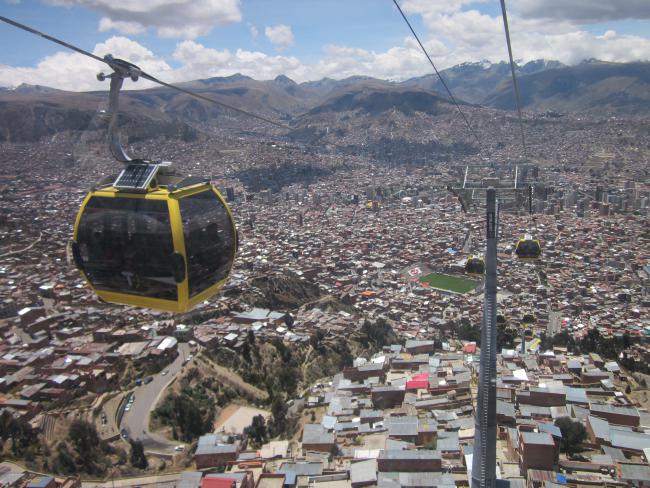
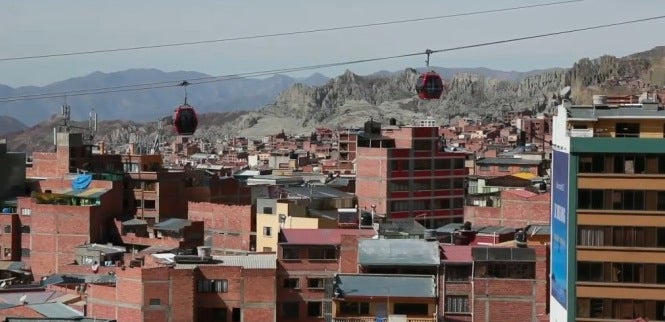
Mile high transit over Bolivia

Bolivia Revolutionizes Urban Mass Transit: From the Streets to the Sky

How a spectacular urban cable car system and a new municipal bus program are revolutionizing mass transit in La Paz and El Alto, with the help of some political competition.

Emily Achtenberg 12/26/2014
(Emily Achtenberg)(Emily Achtenberg)

Those searching for revolution in Bolivia may find it in unexpected places. On the streets and in the sky above La Paz, the nation’s capital, and the neighboring indigenous city of El Alto, a genuine transformation of the urban public transportation system is taking shape, against the backdrop of a political competition that is working to the benefit of local residents.
On December 4, President Evo Morales inaugurated the third line of Mi Teleférico (My Cable Car), the spectacular new cable car system launched last May between La Paz and El Alto. With its Red, Yellow, and Green Lines (the colors of the Bolivian flag), 11 stations, and 427 gondola cabins spanning more than 6 miles at 13,500 feet, it is the longest and highest urban cable car system in the world.
Around 100,000 passengers each day—more than 1 out of every 5 commuters between the two cities—are now riding the teleférico to work or school, to buy or sell goods in the local market, or to enjoy family leisure or tourist activities in one location or the other. Compared to the grueling, unpredictable journey in a packed taxi, minivan, or microbus that is the customary mode of local transit, the popular teleférico offers a quick hop in the sky between sleek, modern terminals, with spectacular vistas along the way and free internet at the stations. While the fare of 3 bolivianos (43c) costs more than a minivan ride, passengers who are elderly, disabled, or students pay only half, and the commute takes less than 20 minutes instead of the usual hour.
Morales points to the teleférico as a showpiece of Bolivia’s modernization, made possible by the past nine years of economic prosperity and political stability under his MAS (Movement Towards Socialism) government. It is also being touted as a symbol of integration, breaking down social, economic, and geographic barriers by connecting distant neighborhoods of indigenous migrants to the city’s commercial center, while opening up opportunities for tourism and investment flows to El Alto. As a political project, the teleférico epitomizes the campaign themes of progress, development, technological advancement, and national unity that propelled Morales and the MAS to an overwhelming victory last October.
While the cable system was constructed by the Austrian firm Doppelmayr—one of a handful of companies in the world with the necessary technical expertise—it is also very much a domestic initiative. The $235 million project cost has been financed entirely by Bolivia, with funds amassed largely from hydrocarbons revenues (taxes and royalties) accruing to the government. The construction workforce is largely Bolivian, and Bolivian engineers and technicians are being trained to operate the system.
The teleférico’s capital cost is expected to be amortized in 25 years—earlier than originally anticipated—through a combination of passenger revenues (75%) and commercial income (25%) generated from retail space and billboard rentals at the stations. (Fortunately, no commercial advertising is permitted on the cable cars, which are decorated instead with messages about important Bolivian laws, and, occasionally, with civic symbols such as soccer balls.) While experts remain skeptical, since virtually no public transit system in the world operates in the black, Morales has predicted that profits from the teleférico will soon be used to subsidize the government’s cash transfer programs.
Morales has pledged another $450 million to construct 5 more teleférico lines starting next year, more than doubling the range of the system. Unlike cable cars built in cities like Caracas and Medellin, which reach only a few isolated hilltop neighborhoods, the La Paz/ El Alto teleférico is uniquely envisaged as the core of an urban mass transit system—a “subway in the sky,” as The New York Times has dubbed it. Austrian president Heinz Fisher will travel to Bolivia to sign the new contract on January 22, the day Morales is sworn in for his third presidential term.
Equally popular in La Paz is the new municipal bus system, PumaKatari, (named for the cougar and serpent that symbolize strength and cleverness in Andean culture). Designed to serve the city’s remote and neglected hillside neighborhoods, the system is especially welcomed by poorer residents who live farthest from the center, and are often denied service or charged extra by taxi and minivan drivers. In some cases, angry residents have mobilized to demand the expulsion of minivan lines that provide poor service to their neighborhoods. The municipal buses, with fares of 28c during the day and 43c at night, may cost a little more than prevailing modes of transportation, but offer the same half-price discounts as the teleférico and the convenience and reliability of fixed stops, schedules, and routes.
PumaKatari is the brainchild of Luis Revilla, the popular La Paz mayor elected in 2010 on the left-center MSM (Movement Without Fear) ticket. Revilla supports the teleférico, but insists that it must be part of, and coordinated with, an integrated mass transit system for the La Paz metropolitan region that is efficient, safe, convenient, and meets residents’ needs.
The first phase of PumaKatari was launched in February 2014—just before the teleférico—with 3 routes and 61 buses manufactured by King Long Motors of China. Four new routes and 73 buses have been commissioned for early 2015, with another 4 routes and 60 buses to follow later in the year. The total $30 million capital cost, along with an initial $4 million operating subsidy, is being financed by the municipality, which in turn receives most of its funds from national sources (principally hydrocarbons revenues).
With Bolivia’s departmental and municipal elections scheduled for next March, transportation politics have become a major battleground in the hotly-contested La Paz mayoralty race. Revilla, forced to form a new party when the MSM was decertified after its poor showing in the national elections, collected more than 50,000 signatures in a week to secure standing for the new Sol.bo (Sovereignty and Liberty) ticket.
Sol.bo has since acquired many adherents, especially among MAS dissidents such as former defense minister Cecilia Chacón and TIPNIS leader (and ex-presidential candidate) Fernando Vargas. The party is now organizing a slate of candidates to run for positions throughout the La Paz department, including ex-MAS education minister Félix Patzi for governor.
With Revilla now being mentioned as a potential future rival to Morales, the mayoral campaign and its related transportation issues have become even more competitive and contentious. At the recent official ceremony inaugurating the teleférico’s new Green Line, Revilla was snubbed in favor of La Paz city councilor Guillermo Mendoza, who is also the new MAS candidate for mayor. (Initially, the head of the state cable car company, César Dockweiler, was widely rumored to be in line to run for MAS.)
Tensions have also arisen over the selection of an interim mayor to replace Revilla, who is legally required to resign by the end of the year in order to run again in March. Revilla has expressed concern that the confirmed designee, a MAS-allied city councilor who recently voted against expanding the PumaKatari bus project (for reasons of cost), could work to undermine his transportation initiatives over the next several months.
Still, there are growing signs of inter-jurisdictional cooperation and coordination around transportation planning in the region. Teleférico stations are being coordinated with PumaKatari bus stops, and the first integrated transfer location was established with the new Green Line in December. The municipalities of La Paz and El Alto have signed an agreement to cooperate in implementing a regional mass transit system, and now meet regularly with representatives of the state cable car company as well as the Ministry of Public Works. El Alto’s counterpart to PumaKatari, the new municipal bus Sariri, is scheduled to start operations early next year, with two routes feeding directly into the teleférico.
The Morales government has also taken critical steps to contain opposition by the powerful MAS-allied transportista (taxi- and minivan-drivers) unions which have threatened to derail both the teleférico and municipal bus initiatives. Morales has guaranteed a $100 million loan from China to enable the La Paz and El Alto unions to purchase 2,000 modern vehicles from King Long Motors (the same company that manufactures the PumaKatari buses). The upgraded fleet will run on natural gas, eliminating the cost of federal gasoline subsidies. Additionally, the government will buy up the old minivans for scrap, and the unions will use the proceeds as a downpayment on China’s loan.
So far, Bolivia’s competitive urban transportation politics seem to be working to everyone’s advantage, and especially to the benefit of La Paz and El Alto residents. Having the resources from hydrocarbons revenues for major national and local projects certainly helps. Meanwhile, showcasing its shiny new cable cars and buses, La Paz has just been named one of the “seven most amazing cities in the world.”

Emily Achtenberg is an urban planner and the author of NACLA’s blog Rebel Currents, covering Latin American social movements and progressive governments (nacla.org/blog/rebel-currents).

Monday, September 29, 2014

Bolivian public transport: cable cars offer unique city views

Here is an article published in the New York Times, by Alissa Walker on 19 August, 2014.

Watch How Bolivia Built The World's Longest Urban Cable Car System

Watch How Bolivia Built the World's Longest Urban Cable Car System
In most parts of the world, cable cars are relegated to ski areas or amusement parks. But in South America, cities use the gondolas to navigate undulating terrain as public transportation. Later htis year, two more lines will open in Bolivia’s La Paz-El Alto network, making it the longest urban cable car system in the world.

This new “subway in the sky” (which looks pretty much like a bunch of ski lifts) is able to lift residents up and over the urban gridlock, allowing them to move between the two city centres faster and more efficiently. As part of a story this weekend, the New York Times made a beautiful video celebrating this rather elegant transit system, which residents call the “red line.”

The potential for this new method of transportation to transform cities like La Paz is huge, where the city is built on veritable alpine cliffs 3600m above sea level. Cable cars provide a light touch on city infrastructure, and can connect steep neighbourhoods where trains are too impractical or expensive. It’s also cleaner and safer than the other alternative — the addition of more crowded minibuses, which will only lead to more streets choked with traffic and pollution.
But the biggest takeaway for riders is that they now feel their city is moving forward, and modernising in a way that will help it keep pace in the global economy (it’s no coincidence these new lines are being finished in time for an election year). Besides their new perspective-changing commute, the cable cars have given the city a signature method of transportation — which brings residents a sense of pride


Tuesday, September 3, 2013

Ronald McDonald gets his booed in Bolivia


(NaturalNews) McDonald's happy image and its golden arches aren't the gateway to bliss in Bolivia. This South American country isn't falling for the barrage of advertising and fast food cooking methods that so easily engulf countries like the United States. Bolivians simply don't trust food prepared in such little time. The quick and easy, mass production method of fast food actually turns Bolivians off altogether. Sixty percent of Bolivians are an indigenous population who generally don't find it worth their health or money to step foot in a McDonald's. Despite its economically friendly fastfood prices, McDonald's couldn't coax enough of the indigenous population of Bolivia to eat their BigMacs, McNuggets or McRibs.

One indigenous woman, Esther Choque, waiting for a bus to arrive outside a McDonald's restaurant, said, "The closest I ever came was one day when a rain shower fell and I climbed the steps to keep dry by the door. Then they came out and shooed me away. They said I was dirtying the place. Why would I care if McDonald's leaves [Bolivia]?"

Fast food chain remained for a decade, despite losses every year

The eight remaining McDonald's fast food shops that stuck it out in the Bolivian city's of La Paz, Cochabamba, and Santa Cruz de la Sierra, had reportedly operated on losses every year for a decade. The McDonald's franchise had been persistent over that time, flexing its franchise's deep pockets to continue business in Bolivia.

Any small business operating in the red for that long would have folded and left the area in less than half that time. Even as persistent as McDonald's was in gaining influence there, it couldn't continue operating in the red. After 14 years of presence in the country, their extensive network couldn't hold up the Bolivian chain. Store after store shut down as Bolivia rejected the McDonald's fast food agenda. Soon enough, they kissed the last McDonald's goodbye.

Deep cultural rejection

The McDonald's impact and its departure from Bolivia was so lasting and important, that marketing managers immediately filmed a documentary called, "Why McDonalds's went broke in Bolivia."

Featuring, cooks, nutritionist, historians, and educators, this documentary breaks down the disgusting reality of how McDonald's food is prepared and why Bolivians reject the whole fast food philosophy of eating.

The rejection isn't necessarily based on the taste or the type of food McDonald's prepared. The rejection of the fast food system stemmed from Bolivian's mindset of how meals are to be properly prepared. Bolivians more so respect their bodies, valuing the quality of what goes into their stomach. The time it takes for fast food to be prepared throws up a warning flag in their minds. Where other cultures see no risk, eating McDonald's every week; Bolivians feel that it just isn't worth the health risk. Bolivians seek well prepared, local meals, and want to know that their food was prepared the right way.

This self respect helps Bolivians avoid processed "restructured meat technology," often used by fast food joints like McDonald's.

The McRib: 70 ingredients all restructured into one

Did you know that the McRib is processed with 70 different ingredients which include azodicarbonamide, a flour-bleaching agent often used in producing foamed plastics? McRib's are basically "restructured meat technology" containing a mixture of tripe, heart, and scalded stomach. Proteins are extracted from this muscle mixture and they bind the pork trimmings together so they can be molded in a factory. The McRib is really just a molded blob of restructured meat, advertised and sold like fresh ribs. There's nothing real about it, the preparation or the substance. In fact, McRibs really came about because of a chicken shortage. The restructured meat technology approach kept the McRib on the menu, despite the shortage, and the profits continued rolling in.

This is the very disgusting idea that the Bolivians have rejected in their country.

The Bolivian rejection of McDonald's has set a proper example for the rest of the world to follow.

Sources for this article include:

http://www.hispanicallyspeakingnews.com

http://www.globalresearch.ca

http://www.theblaze.com

http://www.trueactivist.com/mcdonalds-goes-belly-up-in-bolivia/

Wednesday, August 28, 2013

Bolivia and Holland sign a deal for lithium battery development

Bolivia and Holland this week signed an agreement for a joint project aimed at the manufatcure of lithium batteries in Bolivia. It was signed in La Paz, between Prince Jaime De Borbon Parma, a minister of foreign affairs for Holland, and the Bolivian minister David Choquehuanca. The manager of Recursos Evaporiticos, Luis Alberto Echazu, explained the deal as being in the making, with the intention of coming up with a master plan in the future for implementing a battery production plant in Bolivia and the creation of a scientific research laboratory.
This type of deal allows Bolivia to profit not only from the mining of lithium, but from production as well. In the past Bolivia has mined a great quantity of metals but the smelting and other refning and manufacturing processes have generally been undertaken outside the country.


Dutch Prince Jaime De Borbon Parma

Tuesday, May 7, 2013

Bolivia expels USAID


Bolivian President Evo Morales expels USAID
Evo Morales on 1 May 2013 Evo Morales accused USAID of meddling in the affairs of the Bolivian people

Related Stories

Bolivian President Evo Morales has said he will expel the US Agency for International Development (USAID).
Mr Morales accused the agency of seeking to "conspire against" the Bolivian people and his government.
US state department spokesman Patrick Ventrell rejected the allegations as "baseless and unfounded".
USAID has been working in Bolivia for almost five decades, and had a budget of $52.1m (£33.4m) for the country in 2010, according to its website.
The agency said it deeply regretted Mr Morales' decision.
'Nationalise dignity' On previous May Days, Mr Morales had announced the nationalisation of key industries, such as hydroelectric power and the electricity grid.
But on Wednesday he said he "would only nationalise the dignity of the Bolivian people".
Speaking at a rally in La Paz, the president said there was "no lack of US institutions which continue to conspire against our people and especially the national government, which is why we're going to take the opportunity to announce on this May Day that we've decided to expel USAID".
He then turned to his Foreign Minister, David Choquehuanca, and asked him to inform the US embassy of his decision.
The president said the expulsion was in protest at a recent remark by US Secretary of State John Kerry, who referred to Latin America as "the backyard of the United States".
Mr Kerry made the remark as he tried to persuade US Congressmen of the importance of the region.
Mr Morales has threatened USAID with expulsion in the past, saying that its programmes have "political rather than social" ends. He has also accused it of "manipulating" and "using" union leaders.
Mr Ventrell said Mr Morales' decision "harms the Bolivian people".
"We think the programmes have been positive for the Bolivian people, and fully co-ordinated with the Bolivian government and appropriate agencies under their own national development plan," he said.
In a statement USAID said: "Those who will be most hurt by the Bolivian government's decision are the Bolivian citizens who have benefited from our collaborative work on education, agriculture, health, alternative development, and the environment."
Coca disputes Mr Morales, who heads his country's union of coca growers, has also been critical in the past of US counter-narcotic programmes in Bolivia, repeatedly stating that the fight against drugs is driven by geopolitical interests.
In 2008, Mr Morales expelled the US ambassador and Drug Enforcement Administration (DEA) for allegedly conspiring against his government.
Bolivia is among the top three producers of coca in the world, according to the United Nations World Drug report. Coca, the raw ingredient for cocaine, has been used in the Andes for thousands of years as a mild stimulant and sacred herbal medicine.
USAID cites as its main aims the strengthening of Bolivia's health system and the provision of "equal access to health care by eliminating social exclusion", as well as improving "the livelihoods of economically and socially disadvantaged people by increasing income and managing natural resources".
The agency also supports programmes to help Bolivian farmers to replace coca with other crops.
The US government had a separate budget of $20.3m (£13m) for its counter-narcotics and military programme in 2010, but it is not clear which agency distributes that money in Bolivia.
Evo Morales became Bolivia's first indigenous president in 2005.

Wednesday, February 6, 2013

Bolivian Quaker Education Fund Invitation 2013

Learning the Life of the Spirit


Many Friends in Bolivia - where it is unusually cold this summer season - are returning to school and university after their annual break.
Here, we invite you to join us in visiting among Bolivian Friends, perhaps help make arrangements for a Bolivian Friend to visit here, and share a word (or two) about our new address.
_________________________________________________________________________

You're Invited! 2013 Quaker Service & Study Tour by Barbara Stanford, BQEF Board Member

Visiting Bolivian Quakers in their homes and churches - on the slopes of the Andes, on the high plains around Lake Titicaca, and in the cities of El Alto and La Paz - was one of the highlights of my life. The Quaker Service and Study Tour gave me rich, horizon-expanding opportunities to know and understand Friends in Bolivia and their struggles and dreams.
Sarah and Mabel, two members of the scholarship students' "Messengers of Peace" Andina music group. I visited with BQEF scholarship students and heard about the challenge of moving from remote Aymara-speaking villages to university where materials are in Spanish and English, and about their dreams for improving the lives of their families and communities. We heard their music and song and ate their wonderful food, prepared and shared with warmth and generosity.
I worshiped in a Quaker church whose worship form was very different from mine, but where the Spirit was just as available, and where the congregation was warm and welcoming.
I met farmers raising llamas and hardy crops in some of Earth’s most difficult environments - farmers who were facing ever-greater challenges from the very visible effects of climate change.
Student Residence community members and Quaker Service & Study Tour volunteers work together to remove plants and lay a stone surface in the Student Residence courtyard.For our service project, we worked with parents and staff to complete a drainage project in the courtyard of the Quaker-run Student Residence in the beautiful Sorata valley. We ate, studied, and played with the delightful young people who live there during the school week. And we visited one of the remote mountainside homes from which students had to walk hours to go to school before the Residence was available.
This is an exciting time to visit one of the most beautiful countries in the world - Bolivia is experiencing dramatic social and political change as the indigenous majority emerges from centuries of oppression. The 2013 Quaker Service and Study Tour of Bolivia is now forming. This year, join us in working with individual BQEF scholarship students to help improve their English skills, so necessary for their studies.
Trip extensions are also available. Choose from Cusco - Machu Picchu, a visit to the vanishing Amazon jungle, to "The Mirror of the Heavens" (Salar de Uyuni, the world’s largest lithium-rich salt flat), and/or additional volunteering post-trip in Bolivia.
For more information about the trip, see www.TreasuresoftheAndes.com or contact Barbara Flynn at info@treasuresoftheandes.com, 707-823-6034 (California).
For more information about our scholarship students and the Student Residence in the beautiful Sorata valley, visit www.bqef.org._________________________________________________________________________

We've Moved!

We thank "Founder and Spark Plug" - now President Emeritus - Newton Garver for over a decade of servant leadership, and gladly help lighten his load by moving our U.S. office from his home. Newton will continue serving in an advisory and development capacity.

O
ur new address, effective now:

Bolivian Quaker Education Fund, Inc.
65 Spring Street
Fredonia, NY 14063

Meanwhile, some things haven't changed. Our email and website are still:
office@bqef.org
www.bqef.org

Please send your ideas, questions, volunteer inquiries, and donations to our new address shown above (and at the bottom of this email).
_________________________________________________________________________

Hands-on: Help arrange for a Bolivian Friend to meet US Quakers.

Alicia Lucasi and Ruben Hilari at FGCWould you like to help arrange visits of English-speaking Bolivian Quakers to U.S. Yearly Meetings and Friendly gatherings this summer? Workshop and interest group deadlines are fast approaching. Please email us today at office@bqef.org if you'd like to help arrange a visit, in your area or elsewhere. ________________________________________________________________________

Together

...we can continue to nurture and celebrate the spirit of young Very young Bolivian Friend with sign: "Yo Quiero Ser Luz" (I want to be Light)Bolivian Friends in their dreams of education and fellowship, with your support.

"An investment in Bolivian Quaker young people brings a whole lot of value for a small amount of money" as one of our supporters said.

Please click here to donate online via Network for Good

or send checks to:
Bolivian Quaker Education Fund, Inc.
65 Spring Street
Fredonia, NY 14063-2128

Please contact us if you would like to donate stock, at
office@bqef.org

May Light and Love bless your lives and endeavors.

Jens, Barbara
, Vickey, Bernabé, Juan, Alicia, and all of us here at BQEF and BQE-Bo.

Monday, December 31, 2012

Chef Meyer in the land of Che Guevara

This last day of 2012 has a good feel to it, and when thinking of Bolivia I see some harbingers of good for 2013. So it is appropriate to end this year with an upbeat article about the famous chef Claus Meyer, who is in Bolivia using local ingredients to create a new style. Appropriate - as this country has conrtibuted so much gastronomically to the world - what with the potato and so many other members of the Solanaceous family - Brazil nuts (see post on this blog about them, most are actually grown in Bolivia), etc.
Hopefully when I make my trip to Bolivia Chef Meyer's eatery will be up and running and I can write more from first hand experience - for now, here is the New York Times article:

High Ambition and Visions of Andean Haute Cuisine

By WILLIAM NEUMAN

Published: November 6, 2012

LA PAZ, Bolivia — Bolivia has not been kind to foreigners trying to import revolution. The attempt by the Argentine-born Che Guevara to set off a peasant revolt here ended badly. The verdict is still out on the latest foreigner to arrive in this impoverished nation trying to stir things up.

The Danish celebrity chef Claus Meyer is opening a restaurant in La Paz, hoping to start a Bolivian food movement.
He is a chef, not a Che.
Claus Meyer, a Danish celebrity chef and restaurant entrepreneur, is one of the owners of Noma, a Copenhagen restaurant that is a darling of food critics for its mix of locavore purism and avant-garde cooking methods. Restaurant magazine, a trade journal, ranks it the best restaurant in the world.
Now Mr. Meyer is building a restaurant here, an experiment in Andean haute cuisine that comes with hefty side orders of revolution and high ambition.
Mr. Meyer, who came to Bolivia for the first time last year and has been back three times, described the restaurant, Gustu, due to open in January, as much more than a place to get a fancy meal in the continent’s poorest country. He and his followers describe it as the start of a Bolivian food movement that will rediscover local ingredients like llama meat, chuños (potatoes dehydrated high in the Andes) and coca, the plant that is used to make cocaine but that has long been used here as a mild stimulant, a tea and a medicinal herb.
Gustu’s mission will be to teach Bolivians how to eat in healthier ways, spur economic growth, tourism and exports, support local farmers and turn Bolivian cuisine into the next world food sensation. If all goes well, Mr. Meyer said in a telephone call from Copenhagen, the restaurant will use food “to change the destiny of a country.”
The restaurant, being built in the upscale Calacoto neighborhood, hardly looks like a crucible of revolution. On a recent day, workers installed insulation in the roof. The kitchen was stacked with bags of concrete mix and plaster.
Michelangelo Cestari, one of the restaurant’s head chefs, said it would be the most advanced restaurant in the country, full of high-tech gadgets of molecular gastronomy that atomize, froth and otherwise transform foods.
The restaurant will serve only ingredients grown or created in Bolivia. Wines will come from the country’s handful of wineries and liquor will be limited largely to singani, a local grape brandy.
Mr. Cestari pointed to a tall wall where wines will be stored and displayed, although he said there might not be enough Bolivian labels to fill it at first. The idea, he said, is to help create demand for local products.
Mr. Cestari, a pastry chef, is from Venezuela and has worked for years in fine restaurants in Europe. So has his fellow head chef, Kamilla Seidler, who is Danish. The only Bolivian among the restaurant’s top cooks is Christian Gómez, the senior sous chef, who worked for years in Spain.
They are keenly aware of the risk of being seen as outsiders. “Perhaps it’s arrogant to think we can come here to develop a gastronomy,” Mr. Cestari said, “but we hope we can push something.”
He said the menu would include items inspired by Bolivian dishes, like a lamb on a cross, made by splaying a whole lamb on an iron cross and cooking it slowly over a smoky fire; or calapurca, a soup heated by placing a hot rock in the bowl.
Rather than simply serving typical Bolivian food done well, however, the kitchen will use the method favored by Mr. Meyer in Denmark of focusing on a few basic ingredients and trying to draw out their essence.
“We don’t want to do French food or fusion or nouvelle,” Mr. Gómez said. “We want to do something new with a Bolivian identity.”
Mr. Cestari said that the average dinner tab would be $50 to $60 a person, which he said is on par with other top restaurants here but still prompted several Bolivians to gasp. The minimum wage here is about $143 a month.
Mr. Meyer will address that contradiction soon by opening a bistro and bakery where people can eat more economically. And he said that all profits from the restaurant would go to charitable projects in Bolivia, which he chose partly because it was a developing country with a wide range of unique local ingredients.
The project also includes a cooking school for young Bolivians from poor families, which will provide a trained work force for the restaurant and, Mr. Meyer hopes, create a new generation of experimentally minded chefs.
On a recent morning, students at the school, which is run out of an ornate mansion in central La Paz, buzzed around a cramped kitchen, making pork chops and yucca fries. Then some of them piled into a van for a field trip to a nearby market.
Ms. Seidler, one of the head chefs, said that because she arrived in Bolivia only recently she often finds herself learning from her students. At a market stall, Ms. Seidler and a student, Belén Soria, pored over types of offal. Ms. Soria explained how indigenous women prepared a mixture of fried tripe and potatoes that they sell from carts at night.
Ms. Soria, 24, said she grew up helping her grandmother cook and sell api, a sweet corn gruel that is a workingperson’s inexpensive morning staple.
Everyone has their own knowledge, things their grandparents told them,” she said. But she has less time to help her grandmother now that she is focusing on her studies.
“We’re all curious to prepare new things, with our own stamp,” Ms. Soria said. “Original things.”

Tuesday, January 31, 2012

Mineral Resources in Bolivia

A history of Bolivian mining with a list of its most important mineral resources

From 1557 to 1985, mining dominated the Bolivian economy. By 1987 mining accounted for only 4 percent of GDP, 36 percent of exports, and 2.5 percent of government revenues. Spurred by a massive increase in gold production, the mining sector rebounded in 1988, returning to the top of the nation's list of foreign exchange earners. Tin and silver had been the major products in this sector, making fortunes for a few select families who saw fit to take their wealth out of the country, or for foreign companies with little regard for the native workers. This was much a factor in Bolivia's struggle for independence from Spain. It was not until 1952 that an agency that answered to the governemnt, at least partly, was established; Comibol, which was decentralised into five semiautonomous mining enterprises in 1986. This was a huge multimineral corporation controlled by unions and was the second largest tin enterprise in the world. It operated 21 mining companies, spare-parts factories, electricity plants, farms, a railroad, and other agencies. The decentralisation of Comibol under the Rehabilitation Plan reduced the company's payroll from 27,000 employees to under 7,000 in less than a year. All of Comibol's mines were shut down from September 1986 to May 1987 to examine the economic feasibility of each mine; some never reopened. Comibol's mining and service companies were restructured into five autonomous mining subsidiaries (in Oruro, La Paz, Quechusa, Potosí, and Oriente) and two autonomous smelting companies (the Vinto Smelting Company and the still unopened Karachipampa smelter in Potosí), or they were transferred to ministries. Medium miners, small miners, cooperatives, and other producers, which made up the rest of the mining sector, produced more minerals in 1987 than Comibol. The medium miners consisted of Bolivian and foreign mining companies in the private sector that were involved in the production of virtually every mineral, especially silver, zinc, antimony, lead, cadmium, tungsten, gold, and tin.

Gold Gold prospecting in the country's rivers and mines was brisk in the late 1980s. Because of Bolivia's vast territory and the high value of gold, contraband gold accounted for approximately 80 percent of exports. Official gold exports were approximately five tons in 1988, up sharply from less than one ton in 1985. In order to capture gold as a reserve for the Central Bank, in 1988 the government offered a 5 percent bonus over the international price of gold on local sales to the Central Bank. Gold was mined almost exclusively by over 300 cooperatives throughout the country, along with about 10,000 prospectors. A large percentage of the cooperatives worked in Tipuani, Guanay, Mapiri, Huayti, and Teoponte in a 21,000-hectare region set aside for gold digging and located 120 kilometers north of La Paz. Mining cooperatives in the late 1980s had requested an additional 53,000 hectares from the government for gold prospecting. Others panned for their fortunes in remote villages like Araras along the Brazilian border in Beni. Small-scale operations were very traditional and wasteful. Analysts predicted that more commercial production, such as the dredging of alluvial deposits, would maximize gold output. A few medium-sized mining operations, as well as the Armed Forces National Development Corporation (Corporación de las Fuerzas Armadas para el Desarrollo Nacional--Cofadena) became involved in the gold rush in the 1980s. Government policy favored augmenting gold reserves as a means of leveraging more external finance for development projects. Bolivia's gold production has been steadily rising since 1998. Gold production in the first 6 months of 2003 was estimated at 4 600 t a 18.6% increase from 2002. Production is still dominated by the Into Raymi gold mine that is responsible for over 75% of Bolivia’s production. The mine is situated at Kori Kollo on the Altiplano north of Oruro with Newmont Mining owning 88% and Zeland Mines SA (12%) of the project. The mine began production in 1993 and produced 306 000 oz gold in 2001. However, reserves at the mine are rapidly being exhausted and are currently estimated at 700 000 oz.
Through a local subsidiary, Empresa Minera Paititi, Orvana Minerals has purchased a gold mining concession and related equipment from Comsur. The Don Mario gold deposit is located in eastern Bolivia and has mineable reserves estimated at containing 1.17 Mt grading 10.24 g/t gold for 386,000 oz gold.
Bolivia has several smaller scale gold projects currently undergoing feasibility studies by several foreign companies. Apart from hard rock gold finds, Bolivia has several high grade alluvial gold fields. The largest and highest grade fields are located on the Challana, the Kaka, the Mapirí, and the Tipuani river valleys in northern part of La Paz. Golden Eagle Bolivia are currently evaluating the Tipuani region where the company has secured mining rights over 74 000 acres. The Araras area near the border with Brazil has also been identified as prospective for alluvial gold, in particular the Madera and the Madre de Dios Rivers. More gold as also been discovered this year, along with much silver (see below) at Malku Khota.

Silver Three centuries after being the world's largest producer of silver, Bolivia still produced 225 tons of silver in 1988, as compared with about 140 tons in 1987. Recent finds, such as the one in 2010 by the South American Silver Company at Malku Khota, which is known to be one of the world's largest undeveloped silver resources, will increase mining activity.
Potassium Bolivia also has approximately 110 million tons of potassium, much of which is mixed in with the lithium (see below).

Lithium The lithium and potassium deposits located in the brines of the southern Altiplano's Uyuni saltpan are estimated to be the largest of their kind in the world. The United States Geological Survey, the Bolivian Geological Survey (Servicio Geológico de Bolivia), and others discovered large reserves of lithium in 1976. By 1985 Bolivia's National Congress had made lithium extraction a national priority and created the Industrial Complex of the of Uyuni Saltpan (Complejo Industrial de los Recursos Evaporíticos del Salar de Uyuni) to explore and market lithium. Because the extraction of lithium is an expensive, technically complex process, the government sought bids for some foreign investment in lithium in the late 1980s.
Presently, Bolivia is believed to have over 50% of the world’s supply, and bids are being accepted for mining, with the proviso that lithium batteries be developed in Bolivia.
Manganese The Mutun reserves are located in Bolivia's German Busch province in Santa Cruz, and extend into Brazil. They contain an estimated 10bn tons of manganese. Bolivia's government may seek an agreement with Brazil, similar to the recent gas pipeline contract between the countries, to develop the reserves.

Lead The lead and silver Karachipampa facility in Potosí was the nation's largest smelter. Although the authorities considered lead a minor metal, production increased from 9,000 tons in 1987 to 11,000 tons in 1988.

Tin Bolivia's mines had produced cassiterite, the chief source of tin, since 1861. By the mid-twentieth century, four famlies controlled all or most of the tin, the most prominent being the Patino clan. Between 1978 and 1985, Bolivia fell from the second to the fifth position among tin producers. In the late 1980s, however, tin still accounted for a third of all Bolivian mineral exports because of the strong performance by the medium and small mining sectors. The largest tin-mining company in the private sector was Estalsa Boliviana, which dredged alluvial tin deposits in the Antequera River in northeastern Potosí Department. The Mining Company of Oruro operated the country's richest tin mine at Huanuni. The country's tin reserves in 1988 were estimated at 453,700 tons, of which 250,000 tons were found in medium-sized mines, 143,700 tons in Comibol mines, and 60,000 tons in small mines. In the late 1980s, tin was exported mainly in concentrates for refining abroad. Eighty percent of all exports went to the European Economic Community and the United States, with the balance going to various Latin American countries and Czechoslovakia.
Bolivia was a founding member of the International Tin Council (ITC), a body of twenty-two consumer and producer countries that since 1930 had attempted to regulate tin markets through buffer stocks. Bolivia, however, did not sign the ITC's International Tin Agreements in the 1970s and 1980s. In 1983 Bolivia joined the newly formed Association of Tin Producing Countries, which attempted--unsuccessfully--to control tin prices through a cartel approach to commodity regulation. After a period of decline, tin prices rebounded in the late 1980s.
Government policies since the early 1970s had sought to expand the percentage of metallic or refined tin exports that offered greater returns. As a result, smelting increased during the 1970s, but in the 1980s the excessive costs of the nation's highly underutilized smelting operations contributed to the decision to restructure Comibol.

Bismuth Reserves were estimated at 4,100 tons, and production in 1987 reached two-thirds of a ton entirely by small miners. Bolivia, the site of the International Bismuth Institute, was once the sole producer of bismuth in the world. One of the applications of bismuth is in the making of high grade, long lasting paints, such as bismuth yellow.

Uranium The last mine closed in 1974. The government has set aside $500,000 for research into continuing mining in the future, but there is no date set as yet.

Tungsten Bolivia was also the leading producer of tungsten among market economies. But the dramatic decline in tungsten prices in the 1980s severely hurt production, despite the fact that reserves stood at 60,000 tons. Medium and small producers accounted for over 80 percent of the country's tungsten production in the late 1980s. The International Mining Company's Chojilla mine was the source of most tungsten output. Tungsten production sank from 2,300 tons in 1984 to barely more than 800 tons in 1987 because of falling international prices. Tungsten was sold to West European, East European, and Latin American countries, as well as to the United States.

Zinc This is Bolivia's leading export from the mines. Zinc output also rose in the late 1980s from roughly 39,000 tons in 1987 to over 53,000 tons in 1988, compared with 47,000 tons in 1975. Nearly all zinc was exported. In 1987 the government declared the construction of a new zinc refinery in Potosí a national priority.
Present plans for zinc mining include a $500 million investment in two new plants, to be located in Potosi and Oruro, with production expected to be 200 tons per year. Exports stand at 429 tons (2009), up from 385 the previous year. The 2009 production netted a profit of $685 million.

Magnesium Unknown amounts of magnesium are found in association with lithium. Boron 3.2 tons of boron are known to exist.

Antimony Bolivia mined about a fifth of the world's antimony in the late 1980s and was the leading producer among market economies. Private companies were responsible for all antimony production. The largest output came from the United Mining Company (Empresa Minera Unificada), which controlled the two largest antimony mines, located at Chilcobija and Caracota, both in Potosí Department. Medium and small miners generated an average of 9,500 tons of antimony a year in the mid-to late-1980s, all of which was exported. Antimony, a strategic mineral used in flame-proofing compounds and semiconductors, was exported in concentrates, trioxides, and alloys to all regions of the world, with most sales going to Britain and Brazil. Antimony reserves in 1988 stood at 350,000 tons.
Deposits also exist in Oruro, in western Bolivia, where Glencore, a Swiss firm, had contracts to mine. However, after it failed to invest, and was found to be dismantling the smelter, Mining Minister Jose Pimentel traveled to Oruro to carry out the legal steps necessary for state-owned Empresa Metalurgica Vinto to take control of the smelter.
Iron After years of planning, the Mutún iron mine was scheduled to open its first of two plants in 1989. The Mutún mine, the sole responsibility of the Mining Company of the Oriente, was expected to yield 592,000 tons of iron in its first five years of operation, with an estimated total of 40 billion tons of ore. The prospects for the steel industry, which was controlled by Bolivian Iron and Steel (Unidad Promotora de La Siderurgia Boliviana, formerly known as Siderúrgica Boliviana), however, were bleak. After more than a decade of planning a national steel plant, Bolivia was still unable to obtain financing for such a project, especially given international overcapacity in steel. The possibility of a national steel plant appeared unlikely at the end of the 1980s.
Recent contracts with Jindhal Steel of India came to a halt after Jindhal failed to comply with dealines in the contract. Bolivia has the largest supply of iron in the world, albeit of a medium grade, some mixed with sulfur compounds.

Cadmium Reserves exist in western Bolivia, often mixed with sulfur compounds.

Chromium Like cadmium, it is mined in the west, where it is mixed with sulfur compounds. Neither is mined presently in any great quantities if at all; oxides of both are used in quality artists' paints.

Wednesday, February 9, 2011

Bolivia's Thalia

Years ago NY had two Thalia movie theatres where I spent many happy hours watching vintage films. Now, sadly, those halcyon days have slipped by. But I know where to go to get my fix! La Paz, Bolivia. This and other cities in Bolivia are becoming slowly cultural centres. In preparation a NY acting troupe is gearing up to do skits in Santa Cruz, including comedy, sitcoms and live music. It will be NY without the muggers!
Check out the posting below about the La Paz theatre...

Competitive movie-watching for Bolivia's cinephiles
(AFP) – 23 hours ago
LA PAZ — A Bolivian cineplex on Tuesday announced a film marathon competition likely to test the endurance of even the most avid cinephile.
The challenge is to watch the most uninterrupted movies without leaving the theater and without falling asleep, said organizers of the contest sponsored by the Megacenter cinema concern.
"We're trying to measure the endurance of people watching movies without stopping," Megacenter's chief executive Jose Luis Gomez, who told AFP that the competition gets underway on February 19.
Gomez said that his cineplex would show continual screenings of movies from various film genres and that any contestant leaving the theater for more than five minutes at a time would be eliminated.
More than 50 movies will be screened during the marathon, organizers said -- enough for four days of continuous film viewing.
The lucky winner is to receive one-year free pass for more unlimited movie viewing at Megacenter, the company said.

Tuesday, June 29, 2010

Bolivian coffee

THE BOLIVIAN COFFEE INDUSTRY

Bolivia is a small player: it ranks 38th on the list of coffee-producing nations, even behind the U.S., which ranks 35th. In the last few years, the country’s coffee has made great strides, in part thanks to the Bolivian Specialty Coffee Association (ACEB), and an event called the Cup of Excellence.
The best Bolivian coffees have a very sweet, very balanced cup; aficionados assert that they have a deep berry in flavor; my own impression is that they are nutty, with a hint of caraway. They’re creamy and sweet, one coffee roaster has noted, and a comment on a NYC site about the Coffee Foundry on West 4th Street noted the nutty taste of their Bolivian mix. The proprietors there note that the beans grown at a higher altitude are denser, and thus roast more evenly. Again, a personal impression is that the taste of the Bolivian beans is more noticeable in iced coffees.
The very geography of much of Bolivia is designed to produce coffee, but has also contributed to the country’s struggle to produce consistent specialty coffee. Most farmers de-pulp the coffee at the farm, and then must truck it over the mountains to La Paz at a whopping 12,500 feet, where they deliver it to centralized co-ops or intermediaries. Because the beans were half-processed, they were still wet and would freeze and then thaw again on their way over the mountain. But recent developments in the industry have changed that, and most coffee is not processed locally to avoid such problems.
Bolivian coffee is almost 100 percent arabica, mostly of the typica and criolla varietals. More than 90 percent of the coffee grown in Bolivia is produced in the Yungas area, a tropical region in La Paz with altitudes between 1,600 and 5,200 feet. Other important growing regions are Cochabamba, Santa Cruz and Tarija and Beni.
Before 1991, most farms were owned by wealthy land owners, who had Brazil’s native people work for them. In 1991 a governmental land reform forced the larger landowners to return the farms back to the families who had originally owned them. These small farms, which range in size from 3 to 20 acres, now produce the majority of coffee (estimates range from 85 to 95 percent), despite the fact that often, only a small percentage of the land is dedicated to coffee.
“The Bolivian coffee industry has been fine-tuning itself by producing quality in the cup and improving post-harvest techniques mostly at the wet- and dry-milling stages,” says Marcos Moreno, agribusiness and marketing advisor for the Market Access and Poverty Alleviation (MAPA) project, a USAID-funded project that provides technical assistance to coffee growers in Bolivia. “This is a young coffee industry in the hands of more than 23,000 small growers who are learning to make better coffee and bring home a steady income.”
“It is not a miracle what has been happening lately in Bolivia, but it is the result of hard work on behalf of coffee growers that want to showcase what they can produce and turn around the misconception that Bolivian coffees were a bag full of unpleasant surprises,” Moreno adds.
Most smallholders use little or no fertilizers or pesticides. The coffees are typically hand-picked and washed, and then sun- or machine-dried. New projects, such as those funded by the U.S. to eradicate drugs, helped build coffee processing plants in the main growing regions so that the wet coffee would no longer need to be trucked into La Paz.
Along with ACEB, the U.S. government spent $150,000 to bring the Cup of Excellence program in Bolivia in October and December of 2004. In the first year, 13 Bolivian coffees earned the Cup of Excellence designation. First prize, with a score of 90.44, went to CENAPROC, a co-op that received more than $11 a pound for its coffee. In addition to inspiring more farmers to participate in coming years, the hope is that the potential of this type of money will continue to turn farmers away from coca acreage and into coffee. However, at around $2 a pound, coca still pays at least double the current price of coffee.
Bolivia has all the ingredients to be a high-quality coffee producer, such as altitude, fertile soil, and a consistent rainy season. However, the rugged terrain and lack of infrastructure and technology make post-harvest quality control a challenging task. Funds from development agencies are working to establish processing facilities in rural areas so that farmers have access to the resources that will help ensure quality beans, while also adding value to their product.
Within the entire industry, 28 privately owned firms control more than 70 percent of coffee export trade. The remaining percentage is traded by Bolivia’s 17 coffee cooperatives. Both the private and cooperative sectors are members of the Bolivian Coffee Committee, or Cobolca. Most of Bolivia’s (green) beans are exported to the US, the EU, the Russian Federation, and Japan.
The global coffee crisis has produced devastating effects for Bolivia’s rural farming population, as well as the economy as a whole. With coffee prices reaching as low as $0.40 in early 2002, many producers have been unable to cover the costs of production. Despite a price spike in 1997, coffee production and its value on the international market has been decreasing steadily since the early 1990s. The role of coffee in the national economy fluctuates based on the highly volatile international commodity price, or New York “C” price. In 1997, Bolivia exported 6,725 metric tons of coffee (green) and received $26,040,000, meaning that each metric ton was worth approximately $3872. However, in 2003 coffee exports (green) totaled 4,453 metric tons and returned only $6,389,000, thus valuing each metric ton at a mere $1,4237 . This staggering price disparity reflects (on a smaller scale) the natural boom and bust cycles of the coffee economy, making small-scale farmers extremely vulnerable to cyclical price shocks.
In the past few years specialty labeling (Fair Trade, organic, and shade grown) and the cooperative movement have been gaining momentum among various rural commodity producers. Many cooperatives have united under this movement, yet others are incapable of paying the certification costs, which are considerable in the context of such poverty. ANTOFAGASTA, established near La Paz in 1992, was one of the first cooperatives on the Fair Trade register that sells a portion of their coffee through Equal Exchange’s Fair Trade market.